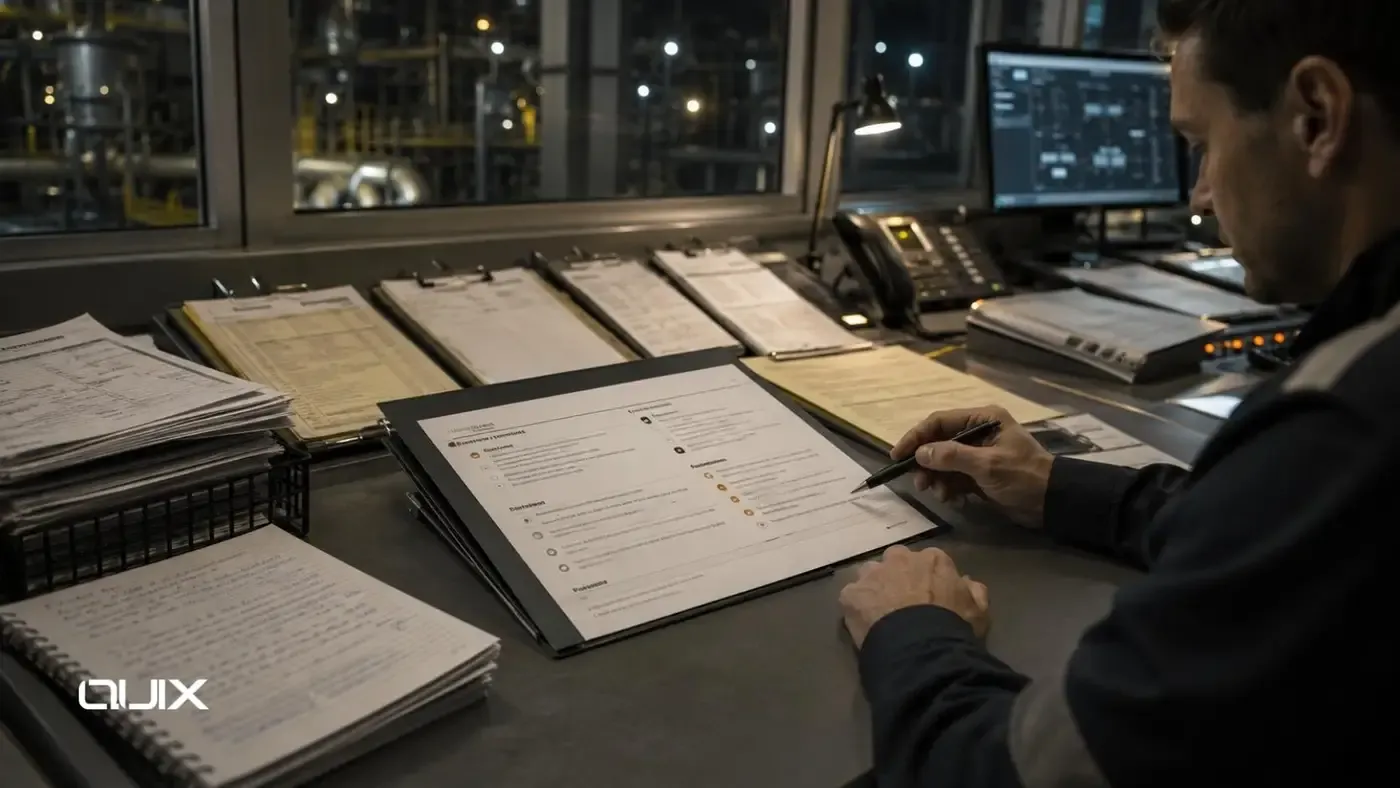
Document-heavy workflows — invoice processing, contract review, compliance screening, insurance claims, loan applications, regulatory filings — share a structural characteristic: high volume, variable format, repetitive extraction tasks, and manual bottlenecks that scale linearly with headcount.
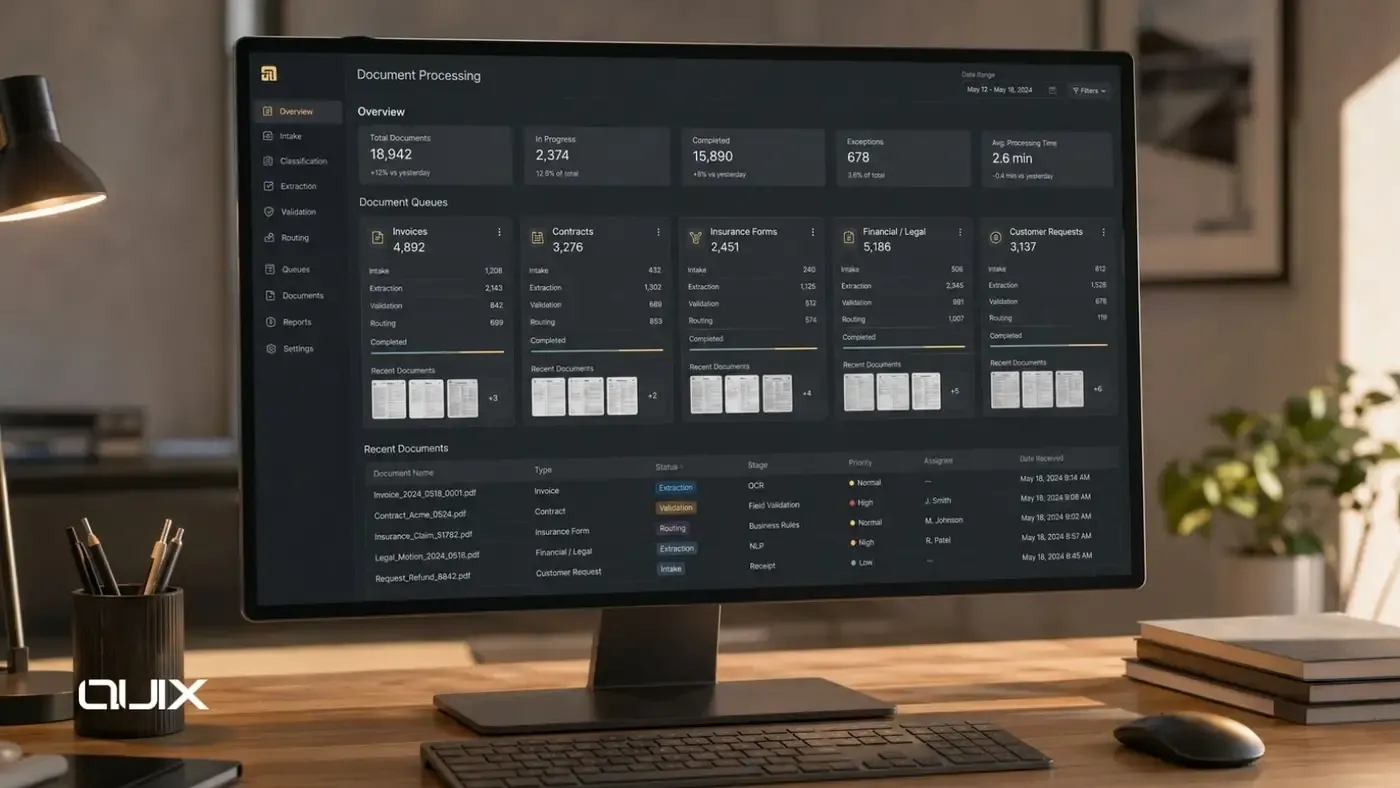
AI document processing addresses this at the architectural level. Rather than adding people to keep pace with document volume, organizations design a processing pipeline that ingests documents, classifies them, extracts the relevant information, validates the extraction against business rules, routes documents to the appropriate handler, and integrates the extracted data with downstream systems — with humans focused on exceptions rather than routine processing.
Executive Summary
AI document processing applies machine learning and language model capabilities to automate the extraction, classification, validation, routing, and integration of information from enterprise documents. When implemented correctly, it converts document-heavy workflows from manual bottlenecks into governed automated pipelines — with human review focused on the exceptions that genuinely require human judgment rather than the routine processing that does not.
The operational return is proportional to document volume: the higher the volume and the more repetitive the extraction task, the greater the return from automation. The governance requirement is also proportional to document sensitivity: documents that contain regulated data, that carry legal significance, or that inform compliance determinations require correspondingly robust audit trails and human verification workflows.
The AI Document Processing Pipeline
Stage 1: Document Ingestion
Documents arrive through multiple channels: email attachments, web portals, uploaded files, API transfers, fax-to-digital conversion, and manual upload. The ingestion stage standardizes these inputs, assigns a document identifier, logs the receipt with metadata (source, timestamp, original filename, receiving team), and queues the document for processing.
Ingestion governance defines what document types are accepted, what happens when an unsupported document type is received (rejection with notification, or routing to manual handling), and how documents are retained and secured during processing.
Stage 2: Optical Character Recognition and Preprocessing
Documents that are not already in machine-readable text format — scanned PDFs, photographed forms, fax images — require OCR to convert visual content to processable text. Modern OCR accuracy for well-formatted printed documents is very high; accuracy for handwritten content, degraded originals, and unusual formats requires validation.
Preprocessing normalizes the text output for downstream processing: removing OCR artifacts, standardizing whitespace, identifying document structure (headers, tables, sections, signatures), and flagging documents where OCR confidence is below the threshold for reliable extraction.
Stage 3: Document Classification
Classification assigns each document to a category that determines how it will be processed: invoice, purchase order, contract, compliance form, insurance claim, identity document. Classification drives the extraction model selection, the validation rules, the routing logic, and the audit requirements that apply to the document.
Classification models should be evaluated on precision and recall across each document category — a misclassified invoice that is routed through a contract processing workflow creates downstream errors that are more expensive to correct than the classification step itself.
Stage 4: Information Extraction
Extraction models identify and pull specific information from each document type: invoice number, vendor name, line items, amounts, due date, and payment terms from invoices; effective date, parties, payment terms, renewal clauses, and termination conditions from contracts; policy number, claim type, incident date, and coverage categories from insurance documents.
Extraction produces a structured output — a data record — for each document, with confidence scores for each extracted field. Fields below a defined confidence threshold are flagged for human verification rather than passed to downstream systems with potentially incorrect values.
Stage 5: Validation and Business Rules
Validated extracted data is checked against business rules: does the invoice total match the sum of line items? Does the vendor appear in the approved vendor list? Does the contract value exceed the authorization threshold for automated approval? Does the identity document meet the required validity criteria?
Rules-based validation catches extraction errors that confidence scoring alone does not catch: a field may be extracted with high confidence but still produce a value that fails a business rule check. Validation errors trigger either correction workflows (if the error is correctable from document context) or human review routing.
Stage 6: Routing, Approval, and Integration
Validated documents and their extracted data are routed to the appropriate handler or approval workflow based on classification, extracted values, and business rules. High-value invoices route to finance management approval. Contracts above a defined value threshold route to legal review. Compliance documents route to the appropriate regulatory team.
Approved documents trigger integration with downstream systems: extracted invoice data populates the accounts payable system, contract key terms are written to the contract management platform, claim data is recorded in the claims management system. This integration eliminates the manual data entry step that currently follows document processing in most organizations.
AI Document Processing Framework
|
Pipeline Stage |
AI Capability |
Human Involvement |
|---|---|---|
|
Ingestion |
Automated receipt, classification queue |
Exception handling for unsupported types |
|
OCR |
Text extraction from image/scan formats |
Low-confidence OCR review |
|
Classification |
Document type assignment from content |
Misclassification correction, model feedback |
|
Extraction |
Field-level data extraction with confidence |
Below-threshold field verification |
|
Validation |
Business rule evaluation on extracted data |
Validation failure investigation and correction |
|
Routing and approval |
AI routing recommendation based on rules |
Approval decision for threshold-governed documents |
|
Integration |
Automated downstream system population |
Exception handling for integration failures |
Document Workflow Automation Checklist
- Is the document volume high enough that manual processing represents a significant capacity constraint?
- Are the document types well-defined, with consistent enough format for classification models to learn from?
- Are the extraction fields for each document type clearly specified with validation rules?
- Is there a confidence threshold policy that defines when human verification is triggered?
- Are the downstream systems ready to receive structured extracted data through API integration?
- Is there an audit trail for each document from ingestion through approval and integration?
- Is there a human exception workflow for documents that fail classification, extraction, or validation?
- Are compliance requirements (data retention, access controls, regulatory reporting) mapped to the pipeline design?
FAQ
What is AI document processing?
AI document processing applies machine learning and language model capabilities to automate the extraction, classification, validation, routing, and integration of information from enterprise documents — converting document-heavy workflows from manual bottlenecks into governed automated pipelines.
What document types benefit most from AI processing automation?
High-volume, consistent-format documents with clearly defined extraction fields: invoices, purchase orders, contracts, insurance claims, loan applications, regulatory filings, compliance forms, and identity documents. The return is proportional to volume and repetition.
What is confidence scoring in document extraction?
Confidence scoring is the extraction model's assessment of how certain it is that each extracted field value is correct. Fields below a defined confidence threshold are flagged for human verification rather than passed directly to downstream systems, preventing inaccurate values from propagating through the workflow.
How does AI document processing comply with data regulations?
Compliance is built into the pipeline design: data retention policies determine how long documents are stored at each stage, access controls restrict which personnel can access processed document data, audit trails log every processing action with timestamps and operator identifiers, and regulatory reporting requirements are mapped to specific extraction fields and reporting workflows.
What is the right trigger for human review in document processing?
Human review should be triggered by: OCR confidence below threshold for degraded originals, classification uncertainty for unusual document types, extraction confidence below threshold for critical fields, business rule validation failures, and approval requirements for documents above defined value or risk thresholds.