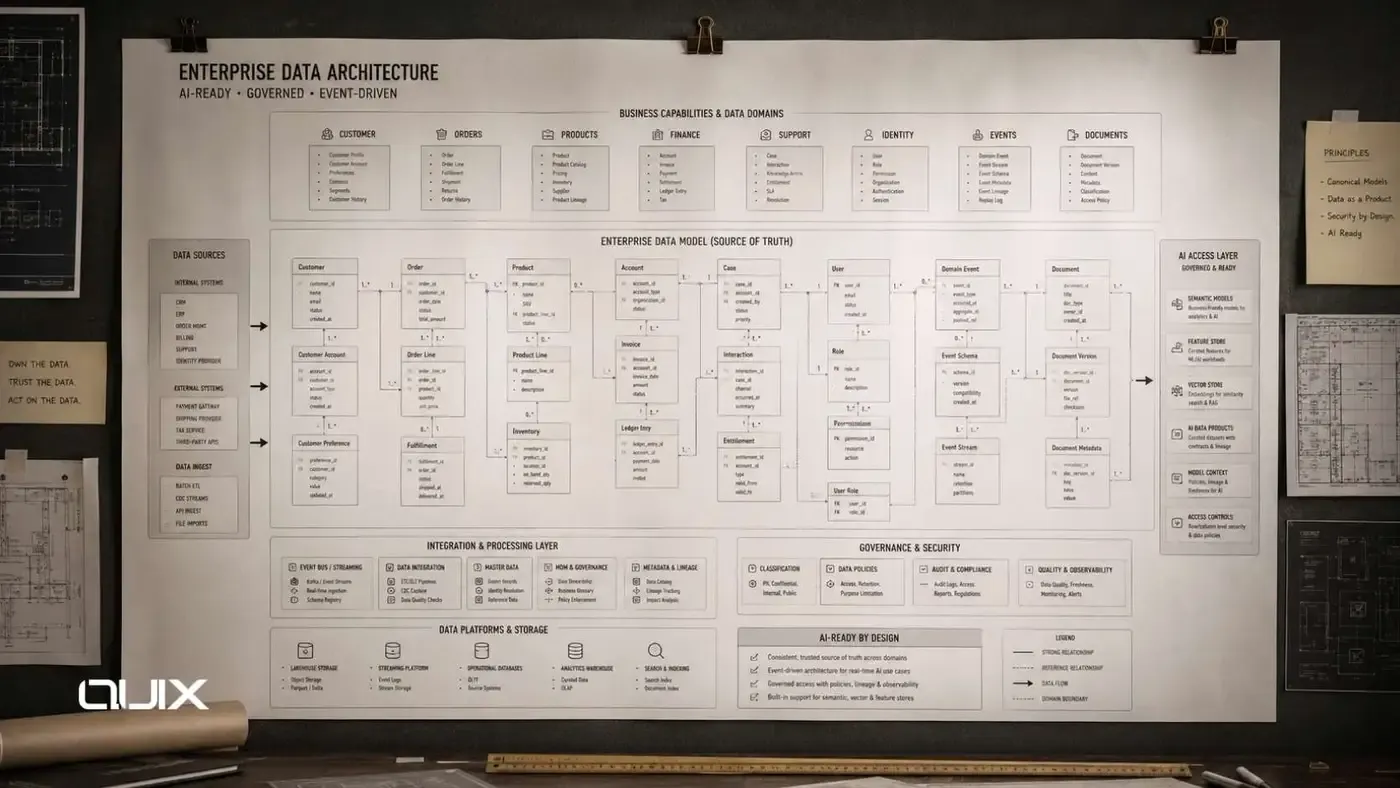
Most enterprise AI projects do not fail because the model is wrong. They fail because the system underneath it was never designed to support intelligence.
This is the pattern Quix encounters consistently when organizations bring us in after an AI initiative has stalled. The proof of concept worked. The business case was approved. The model was capable. But when the team tried to deploy AI inside real operations, the architecture could not support it. Data was fragmented across systems that did not speak to each other. Workflows were inconsistent and undocumented. Governance did not extend to AI access. Integration was too brittle to expose operational context to a model reliably.
AI readiness is not a property of the AI model. It is a property of the enterprise system that hosts it.
Executive Summary
Designing enterprise systems for AI readiness means ensuring that the architecture, data infrastructure, integration layer, workflow design, governance model, and security controls are structured to support intelligent automation, analytics, and AI-assisted decision-making at operational scale.
AI-ready systems are not fundamentally different from well-designed enterprise systems. The requirements for AI — clean data, structured workflows, reliable integrations, clear permissions, observability — are the same requirements that make enterprise systems effective for human operations. The difference is that AI surfaces poor system design faster and more visibly.
This article explains how to build AI readiness into enterprise system design, what the most common structural gaps look like, and how to use the Quix AI-Ready Enterprise Systems Framework to assess your current architecture.
Why Enterprise AI Fails at the System Level
The failure modes of enterprise AI are well documented and consistent across industries. Models perform well in controlled environments and break down in production. Automation pilots succeed and then cannot be scaled. Analytics tools produce insights that no one acts on because the data feeding them is not trusted.
In almost every case, the root cause is a system design problem, not a model problem.
When workflows are informal and inconsistent, AI cannot learn from them reliably. When data is fragmented across systems with different formats, schemas, and ownership rules, AI cannot access a coherent operational picture. When integration is brittle, AI-triggered workflows fail silently. When governance is absent, AI operates without the access controls that production deployment requires.
Solving these problems after AI has been deployed is significantly more expensive than addressing them as part of system design. The organizations that deploy enterprise AI successfully are not necessarily the ones with the most advanced models. They are the ones whose underlying systems were designed to support AI from the start.
The Seven Pillars of AI-Ready Enterprise System Design
1. Structured, Accessible Data
AI models need data that is consistently structured, accessible through defined interfaces, and governed at the field level. This means data with clear schemas, defined ownership, complete records, and minimal null values in fields the model depends on.
Most enterprise systems generate data in formats that reflect how the system was configured rather than what AI downstream will need. Designing for AI readiness means defining data schemas with future consumption in mind, not just immediate storage requirements.
2. Real-Time Integration Access
AI that operates on stale data produces stale recommendations. For AI to add value in operational workflows — routing decisions, priority scoring, exception flagging, personalization, forecasting — it needs access to current operational data, not batch exports.
This requires event-driven integration architecture, well-designed API access layers, and clear data contracts between the systems that generate operational data and the AI systems that consume it.
3. Workflow Clarity and Documentation
AI can assist or automate workflows. It cannot invent them. The workflows that AI will participate in must be formally defined with clear inputs, outputs, decision points, exception paths, and ownership before AI is introduced.
When AI is introduced into informal or inconsistent workflows, it either fails on edge cases the workflow design did not account for, or it encodes informal behavior at scale — which is frequently worse than the original manual process.
4. Governance and Permission Architecture
Enterprise AI must operate within defined permission boundaries. Which data can the AI model access? Which records can it modify? Which decisions can it make autonomously versus which require human review? Which outputs must be logged and auditable?
These governance requirements must be built into the system architecture, not added as afterthoughts. AI systems that operate without permission architecture create compliance risk, data security vulnerabilities, and audit failures.
5. Human-in-the-Loop Design
Not every AI output should trigger autonomous action. High-stakes decisions — contract approvals, customer communication, financial transactions, compliance determinations — typically require human review even when AI contributes to the recommendation.
AI-ready systems design human-in-the-loop checkpoints into the workflow architecture. They define when AI recommendations are displayed for human confirmation, when they trigger autonomous action, and what happens when the AI confidence level falls below the threshold for autonomous operation.
6. Observability and Model Monitoring
AI behavior in production is not static. Model performance changes as data distributions shift, as operational patterns evolve, and as the business context changes. Enterprise systems that host AI must include observability infrastructure: logging of model inputs and outputs, performance dashboards, drift detection, error alerting, and rollback capability.
Without observability, AI degradation is invisible until it has already affected operations. With observability, organizations can detect and correct model behavior before it creates significant business impact.
7. Scalable AI Infrastructure
AI workloads have different infrastructure requirements from traditional enterprise applications. Inference at scale requires low-latency API access, appropriate compute resources, caching strategies, and capacity planning that accounts for concurrent usage patterns.
Enterprise systems designed for AI must include infrastructure that can handle AI workload characteristics without degrading the performance of the operational systems that depend on the same integration and data layers.
The Quix AI-Ready Enterprise Systems Framework
At Quix, we evaluate and design AI readiness across six integrated dimensions. Each dimension addresses a distinct layer of the system architecture that AI depends on.
|
Dimension |
Design Requirement |
AI Impact If Absent |
|---|---|---|
|
Data Foundation |
Structured, owned, consistent, accessible data |
Model consumes unreliable or incomplete inputs |
|
Integration Layer |
Real-time API access with defined data contracts |
AI operates on stale or inaccessible operational data |
|
Workflow Architecture |
Defined, documented, governed process flows |
AI fails on edge cases or encodes informal behavior |
|
Permission Model |
Role-based access controls extended to AI identities |
Compliance risk, audit failure, data security gaps |
|
Human-in-the-Loop |
Defined review checkpoints for high-stakes decisions |
Autonomous AI action on decisions requiring human judgment |
|
Observability |
Logging, monitoring, drift detection, alerting |
Degrading model performance goes undetected in production |
AI Readiness Checklist
Use this checklist to assess the AI readiness of your current enterprise system architecture. A pattern of "no" answers indicates the foundational work that must be completed before AI deployment will produce reliable production results.
- Is the data required for your planned AI use cases structured, complete, and consistently formatted across source systems?
- Does each critical data entity have a defined source of truth and a governance process for corrections and updates?
- Can AI systems access operational data in real time or near-real time through defined API or event-driven interfaces?
- Are the workflows that AI will participate in formally documented with defined inputs, outputs, and decision logic?
- Have exception paths and edge cases been defined for workflows where AI will operate?
- Is there a permission model that defines what data AI systems can access, read, and modify?
- Are high-stakes AI decisions routed through human review before triggering autonomous action?
- Is there infrastructure to log AI inputs, outputs, and performance metrics for monitoring and audit?
- Is there a process for detecting and responding to model performance degradation in production?
- Is the integration architecture stable enough to provide reliable data access to AI systems under operational load?
Common Mistakes in Enterprise AI Readiness
The most common mistake is deploying AI before the data architecture is ready. Organizations invest in model development and discover at deployment that the data the model needs is not accessible in the required format, completeness, or frequency. Data preparation then becomes the main constraint, and the model investment is held hostage to a data engineering backlog.
A second mistake is treating AI as a standalone capability rather than a system component. AI does not operate in isolation. It consumes data from operational systems, executes actions through integration layers, operates within governance frameworks, and produces outputs that must be monitored and audited. System design must treat AI as an integrated component, not an external add-on.
A third mistake is skipping human-in-the-loop design. Organizations under pressure to demonstrate AI value sometimes deploy autonomous AI action on decisions that carry significant business or compliance risk. When the model makes an error at scale, the consequences are significantly larger than an equivalent human error. Human-in-the-loop design is not a limitation of AI ambition. It is a risk management requirement.
A fourth mistake is ignoring observability until something goes wrong. AI model performance is not self-correcting. Without monitoring, drift, degradation, and bias accumulate silently until operational impact forces a reactive response. Observability infrastructure should be part of the initial deployment, not a post-incident investment.
Implementation Sequence
For organizations preparing to deploy AI in enterprise operations, the implementation sequence matters as much as the technology choices.
Phase 1: Data Foundation
Before any model development begins, establish data ownership, improve data quality for the target use case, define access interfaces, and validate that the data the model needs is accessible, complete, and consistently structured.
Phase 2: Workflow and Governance Design
Define and document the workflows AI will participate in. Establish the permission model for AI system identities. Design human-in-the-loop checkpoints. Define the governance process for AI outputs, corrections, and escalations.
Phase 3: Integration and Infrastructure
Build or validate the integration layer that connects operational systems to AI components. Establish observability infrastructure. Validate that the integration can support AI workload characteristics under realistic load.
Phase 4: Controlled Deployment and Monitoring
Deploy AI in a controlled environment with full observability. Monitor model performance against defined metrics. Refine permission boundaries and human-in-the-loop thresholds based on real operational behavior before expanding to broader deployment.
FAQ
What does it mean for an enterprise system to be AI-ready?
An AI-ready enterprise system has structured, accessible data, real-time integration access, documented workflows, a permission model that extends to AI identities, human-in-the-loop design for high-stakes decisions, and observability infrastructure for monitoring AI performance in production.
Why do enterprise AI projects fail at the system level?
Enterprise AI fails when the underlying system is not designed to support it: data is fragmented or inconsistent, workflows are informal, integration is brittle, governance does not extend to AI, and observability is absent. The model may be capable, but the system cannot sustain production AI operation.
What is human-in-the-loop design in AI-ready systems?
Human-in-the-loop design defines which AI decisions trigger autonomous action and which require human review before executing. It is a risk management requirement for high-stakes decisions and a governance requirement for compliance-sensitive operations.
How does data architecture affect AI readiness?
AI models depend on data that is consistently structured, complete, and accessible in real time. Poor data architecture — fragmented sources, absent ownership, inconsistent formats — is the single most common cause of AI project failure in enterprise environments.
What is the right sequence for building AI-ready enterprise systems?
Establish the data foundation first, then design workflow and governance architecture, then build integration and observability infrastructure, then deploy AI in a controlled environment with full monitoring before expanding to broader operational use.