Growth does not usually break a company because the team lacks tools. It breaks because the tools, workflows, data, ownership, and decision paths were never designed to operate as one system.
That is the real job of enterprise system design.
For a scaling company, the question is not simply, "Which software should we buy?" The better question is: "How should our business operate when the number of customers, teams, products, markets, and decisions multiplies?" Enterprise system design answers that question before complexity turns into operational debt.
At Quix, we see enterprise system design as the foundation for every serious digital transformation initiative. It comes before implementation. It comes before AI. It comes before choosing platforms. Without it, companies often end up with expensive tools, fragmented processes, duplicated data, and teams that still depend on manual work to keep operations moving.
Executive Summary
Enterprise system design is the strategic and technical discipline of designing how an organization’s processes, platforms, data, integrations, people, and governance work together as one scalable operating model.
It helps enterprise teams move from disconnected tools to connected operations. It gives CTOs a clear system architecture. It gives COOs visibility into workflows and ownership. It gives CEOs a practical path to scale without adding unnecessary complexity.
A strong enterprise system design does not start with technology. It starts with the operating reality of the business: how work moves, where decisions happen, what data matters, which teams own which actions, and where automation can reduce friction without creating risk.
For scaling companies, enterprise system design becomes critical when growth exposes gaps in the operating model. Typical signals include duplicated manual work, unreliable reports, inconsistent customer experiences, slow handoffs, tool overload, unclear ownership, and AI initiatives that cannot access clean or connected data.
What Is Enterprise System Design?
Enterprise system design is the process of designing the structure, logic, and interaction model of the digital systems that run a company. It defines how business processes, applications, data flows, integrations, users, permissions, automation, and reporting should work together across the organization.
In practical terms, enterprise system design translates business operations into a system architecture that can scale.
The goal is not to create a beautiful technical diagram. The goal is to create scalable systems that help the company operate with more speed, visibility, control, and intelligence.
- Which processes should be standardized, automated, or redesigned?
- Which systems should own customer, product, financial, or operational data?
- How should CRM, ERP, finance, support, delivery, analytics, and internal tools communicate?
- Where should human approval remain necessary?
- Which workflows should trigger automatically?
- What data should be available in real time?
- How should the architecture support future AI solutions?
Why Scaling Companies Need Enterprise System Design
When a company is small, informal systems can survive. People know who to ask. Data can be corrected manually. A few spreadsheets can fill the gaps between tools. Leadership can still see most of the business through direct communication.
As the company scales, that model breaks.
The sales team may work in one CRM structure. Operations may track delivery in another tool. Finance may rely on exported spreadsheets. Support may use customer information that is not synced with account data. Leadership may receive reports that are already outdated by the time they are reviewed.
This is where enterprise system design becomes a growth requirement rather than a technical luxury.
Without a designed system, growth creates friction. More people create more handoffs. More tools create more data silos. More customers create more exceptions. More dashboards create more disagreement about what is true.
With a designed system, growth becomes easier to absorb. Processes are clear. Data ownership is defined. Integrations reduce manual work. Reporting becomes reliable. Teams can make decisions from the same operational reality.
Enterprise System Design vs. Enterprise Architecture
Enterprise system design and enterprise architecture are closely related, but they are not identical.
Enterprise architecture usually looks at the broader structure of the organization’s technology landscape. It includes business architecture, application architecture, data architecture, infrastructure, security, governance, and long-term technology strategy.
Enterprise system design is more execution-focused. It turns the operating model into practical system logic: workflows, data movement, integration rules, automation triggers, user roles, dashboards, and implementation priorities.
For Quix, the value is in connecting all three. A system that looks correct on a diagram but fails inside daily operations is not a successful enterprise system. A scalable system must reflect how the business works now, how it should work next, and how it needs to evolve as the company grows.
- Enterprise architecture defines the technology landscape.
- System architecture defines how the technical components interact.
- Enterprise system design defines how the business actually runs through those systems.
The Core Layers of Enterprise System Design
A strong enterprise system design should cover more than software selection. It should define the operating logic of the company across several layers.
1. Operating Model
The operating model defines how the business creates, delivers, and measures value. It clarifies teams, responsibilities, handoffs, decision points, service lines, customer journeys, and internal dependencies.
This layer matters because technology should support the operating model, not hide its weaknesses. If ownership is unclear before implementation, software will only make the confusion faster.
2. Process Architecture
Process architecture maps how work moves across the organization. It shows the path from trigger to outcome: a lead becomes an opportunity, an order becomes a delivery workflow, a support request becomes a resolution, a finance event becomes a report.
Good process architecture identifies what should be standardized, what should remain flexible, and where exceptions need governance.
3. Data Architecture
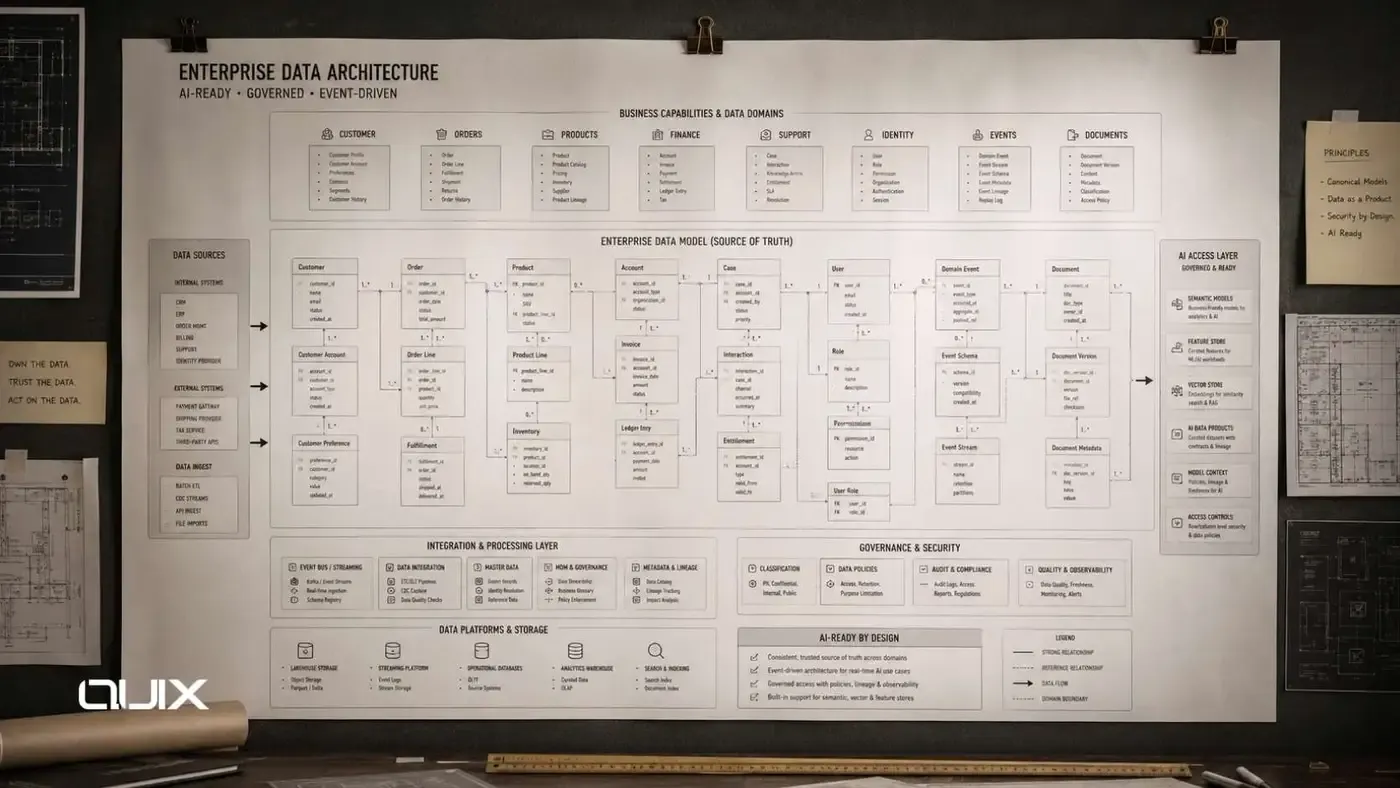
Data architecture defines which data exists, where it lives, who owns it, how it changes, and how other systems use it. This is one of the most important parts of enterprise system design because data quality shapes everything else: reporting, automation, AI, customer experience, and operational control.
If multiple systems disagree about customer status, contract value, delivery stage, or support history, the organization cannot make reliable decisions at scale.
4. Application Landscape
The application landscape shows which platforms and tools are required to run the business. This may include CRM, ERP, support platforms, finance systems, project management tools, internal portals, data warehouses, analytics tools, and AI interfaces.
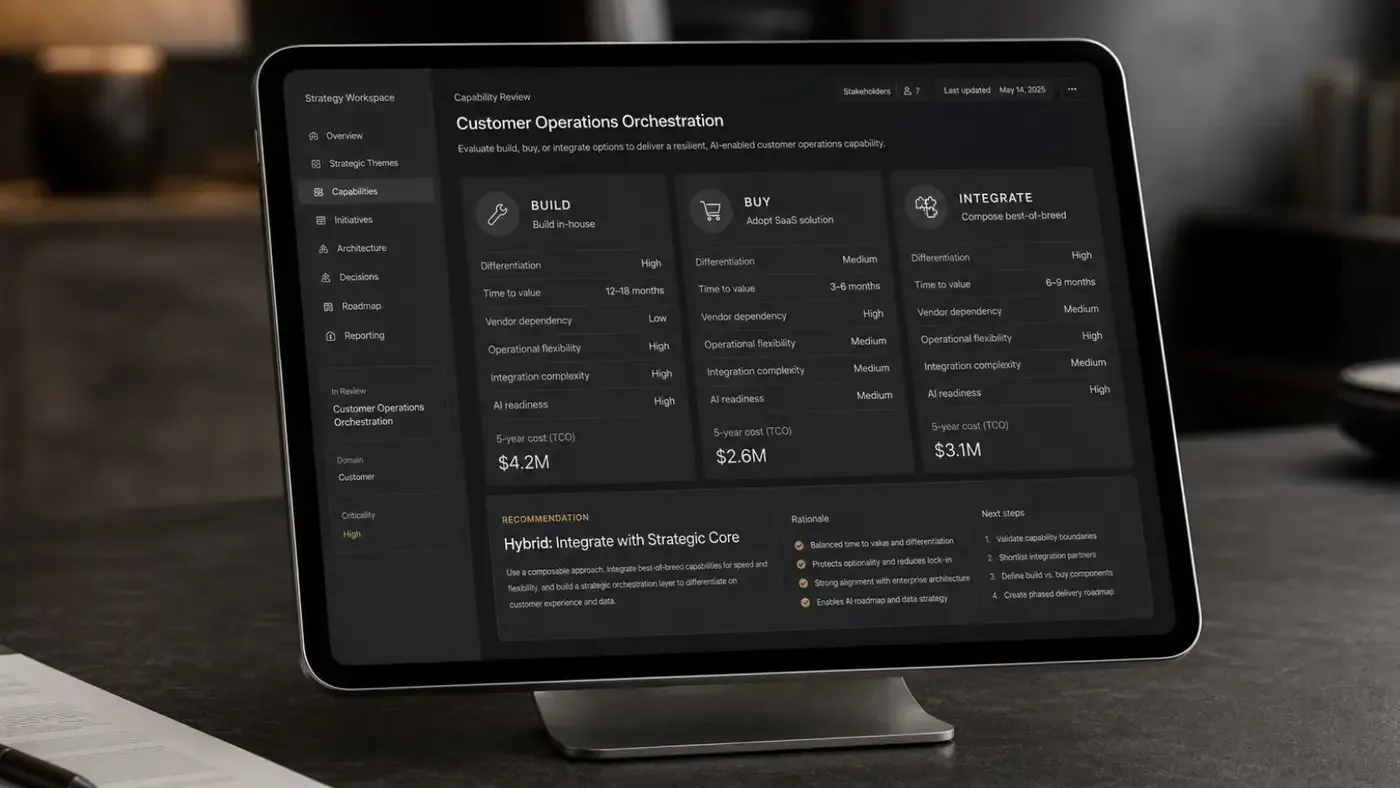
The objective is not to add more tools. The objective is to define which systems are essential, which should be replaced, which should be integrated, and which should be retired.
5. Integration Model
The integration model defines how systems communicate. This includes APIs, middleware, event-driven workflows, batch synchronization, webhooks, data pipelines, and integration governance.
In many enterprises, integration is where system design succeeds or fails. A company can have strong individual tools and still operate poorly if those tools do not share accurate data at the right time.
6. Governance, Security, and Access
Enterprise systems need clear rules. Who can access sensitive data? Who can approve changes? Which workflows require human review? How are errors handled? What happens when data conflicts between systems?
Governance is not bureaucracy. In scalable systems, governance protects speed by making decision rights, controls, and responsibilities clear.
7. Automation and AI Readiness
AI works best when the enterprise system is already structured. If data is fragmented, workflows are inconsistent, and ownership is unclear, AI will amplify the mess instead of fixing it.
Enterprise system design prepares the organization for automation and AI by creating clean workflows, reliable data flows, clear permission models, and measurable processes.
The Quix Enterprise System Design Framework
At Quix, we design systems before we choose tools. The framework below is how we structure enterprise system design for scaling companies.
|
Layer |
Design Question |
Output |
|---|---|---|
|
Business Logic |
How does the company create and deliver value? |
Operating model map |
|
Workflow Logic |
How does work move between teams and systems? |
Process architecture |
|
Data Logic |
What data matters, where does it live, and who owns it? |
Data ownership model |
|
System Logic |
Which applications are needed and how should they interact? |
System architecture map |
|
Integration Logic |
How should data and actions move between platforms? |
Integration blueprint |
|
Intelligence Logic |
Where can automation or AI improve speed, quality, or control? |
AI readiness roadmap |
This framework keeps enterprise system design grounded. It avoids the common mistake of starting with a vendor, platform, or feature list. The system is designed around the business first, then translated into technology.
Signs Your Company Needs Enterprise System Design
A scaling company usually needs enterprise system design before leadership formally names the problem. The symptoms appear inside daily operations.
You may need enterprise system design if:
These are not isolated technology issues. They are system design issues.
- Teams are using different tools to track the same customer, project, or transaction.
- Reports take too long to prepare and still create disagreement.
- Critical workflows depend on manual follow-ups or private spreadsheets.
- Customer experience changes depending on which team handles the request.
- New hires struggle because processes live in people’s heads.
- Leadership cannot see the real-time status of operations.
- Automation projects keep failing because the underlying workflow is unclear.
- AI initiatives are blocked by poor data structure or fragmented systems.
- Your company has outgrown the tools that helped it reach the current stage.
A Practical Roadmap for Enterprise System Design
A useful enterprise system design project should move through clear stages.
Step 1: Diagnose the Operating Reality
Start by mapping how the business actually works today. Interview stakeholders, review workflows, inspect systems, identify manual workarounds, and compare leadership’s assumed process with the real process used by teams.
This stage often reveals the gap between official operations and practical operations.
Step 2: Define the Target Operating Model
Next, define how the company should operate at the next stage of growth. This includes roles, responsibilities, workflow standards, customer journeys, reporting needs, control points, and scalability requirements.
The target model should be realistic. The goal is not to create an idealized enterprise diagram. The goal is to design an operating model the organization can actually adopt.
Step 3: Map Systems and Data Ownership
Identify all major systems and define ownership for key data entities. Customer data, employee data, product data, financial data, contract data, support data, and operational status should all have clear sources of truth.
Without this clarity, integrations become fragile and reporting becomes unreliable.
Step 4: Design the Integration and Automation Logic
Once data ownership is clear, design how systems should communicate. Define where APIs, middleware, event triggers, workflow automation, and data pipelines are needed.
This is also where AI readiness should be evaluated. Not every workflow should be automated. Not every process needs AI. The best opportunities are usually high-volume, rules-based, data-heavy, or decision-support workflows.
Step 5: Prioritize the Implementation Roadmap
Enterprise system design should end with priorities, not just documentation. The roadmap should define what to build, integrate, replace, automate, or retire first.
A good roadmap balances business impact with implementation complexity. It should create visible improvements early while protecting the long-term architecture.
Common Mistakes in Enterprise System Design
The most common mistake is starting with tools. Companies often choose a platform before they understand their operating model. This creates expensive implementations that still require manual work.
Another mistake is designing around departments instead of workflows. Customers, data, and value do not move neatly inside one department. Enterprise system design must follow the work across teams.
A third mistake is ignoring adoption. A system can be technically correct and operationally rejected. If users do not understand the workflow, trust the data, or see the value, they will create shadow systems outside the official architecture.
A final mistake is treating AI as a shortcut. AI cannot replace system design. It needs system design. Without clean processes, clear data ownership, and integration logic, AI solutions become isolated experiments instead of enterprise capabilities.
Enterprise System Design Checklist
Before investing in new software, automation, or AI, leadership should be able to answer these questions:
If the answer is no to several of these, the next step is not another tool. The next step is enterprise system design.
- Do we have a clear map of our current operating model?
- Are our most important workflows documented across teams?
- Do we know which systems own each critical data type?
- Are our reports based on reliable and consistent data?
- Are manual workarounds visible and measured?
- Do our tools integrate in a way that supports real operations?
- Do we have governance for access, approvals, and data changes?
- Can our architecture support future automation and AI use cases?
- Do we have an implementation roadmap tied to business impact?
Final Thoughts
Enterprise system design gives scaling companies the structure they need before complexity becomes expensive. It turns fragmented tools into connected operations, unclear processes into scalable workflows, and disconnected data into a foundation for better decisions.
For enterprise leaders, the value is not just technical. It is strategic. Better system design improves speed, accountability, visibility, customer experience, and AI readiness.
The companies that scale well do not simply buy more software. They design the systems that allow people, data, tools, and decisions to move together.
If your company is preparing for growth, modernization, integration, or AI transformation, start with the system. Everything else depends on it.
FAQ
What is enterprise system design?
Enterprise system design is the process of designing how an organization’s processes, applications, data, integrations, users, governance, and automation work together as one scalable system.
How is enterprise system design different from enterprise architecture?
Enterprise architecture defines the broader technology and business landscape. Enterprise system design is more practical and operational. It translates business workflows into system logic, integration rules, data flows, and implementation priorities.
When should a company invest in enterprise system design?
A company should invest in enterprise system design when growth creates operational complexity: disconnected tools, manual workflows, unreliable reporting, unclear ownership, inconsistent customer experience, or blocked automation and AI initiatives.
Why is enterprise system design important for AI?
AI needs structured workflows, reliable data, clear access rules, and connected systems. Enterprise system design creates the foundation that allows AI solutions to work safely and effectively inside real business operations.
What does Quix deliver in an enterprise system design project?
Quix can help define the operating model, process architecture, data ownership model, system architecture, integration blueprint, automation opportunities, AI readiness roadmap, and implementation priorities for a scalable enterprise system.