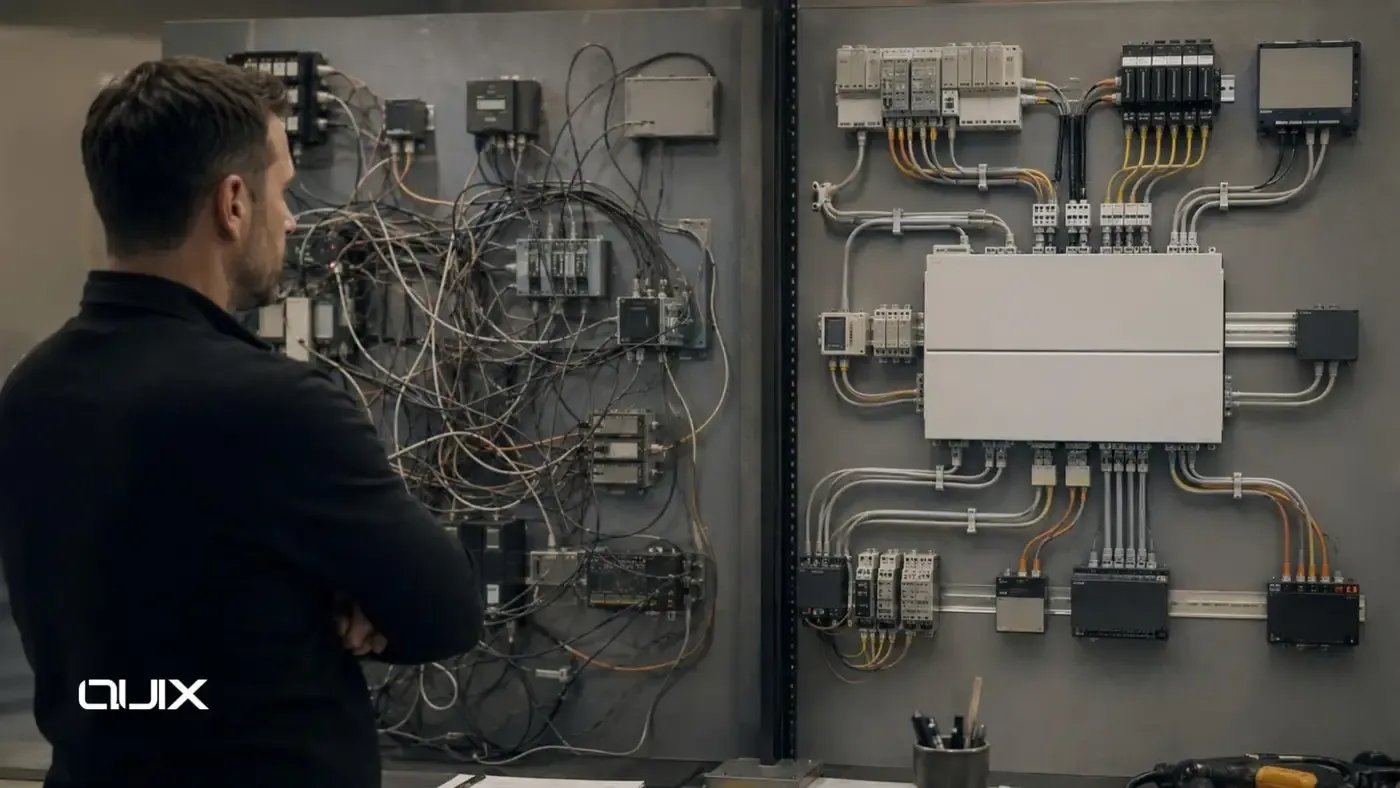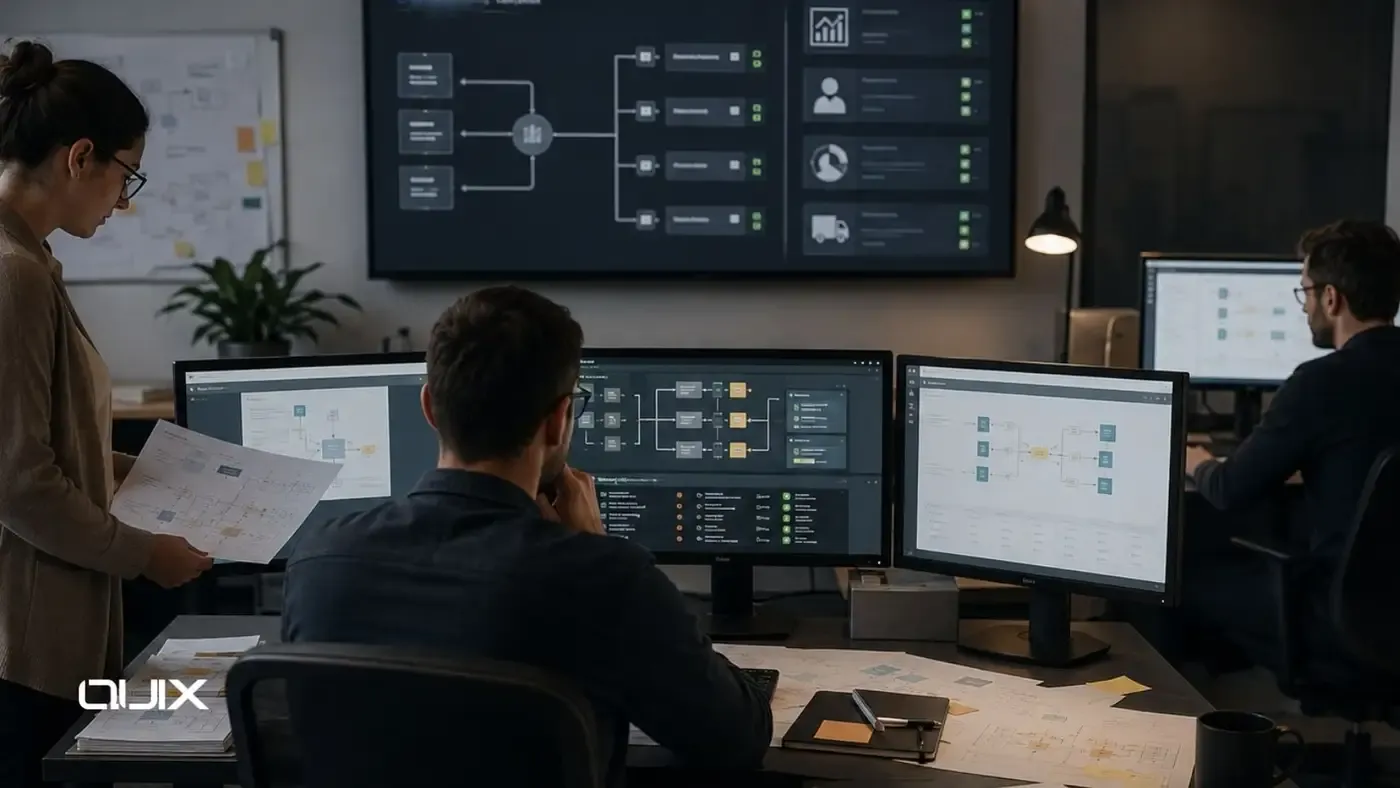
The cost of disconnected business tools is rarely visible in a single invoice or a single incident. It accumulates in the hours spent moving data between systems that should speak to each other, in decisions made on information that is days old, in customer experiences that vary depending on which team handled the interaction.
Enterprise system integration is the architectural discipline that addresses this directly. It replaces the manual bridges, exported spreadsheets, and informal workarounds that hold disconnected tools together with designed data flows, governed integrations, and a connected digital ecosystem that reflects the actual operating model of the business.
Executive Summary
Enterprise system integration is the process of designing and implementing structured connections between the tools, platforms, data stores, and workflows that run a business, so that data moves reliably between systems without manual intervention and operations are visible across functions in real time.
The goal is not simply to connect tools. It is to design a connected operating ecosystem where each system performs its intended function, data ownership is clear, and the organization gains the operational visibility and automation capability that disconnected tools cannot provide.
This article explains what enterprise system integration covers, why disconnected tools create compounding operational costs, the most common integration patterns, and how to use the Connected Enterprise Integration Framework to assess your current environment.
What Enterprise System Integration Actually Covers
Enterprise system integration is broader than connecting two applications. In a scaling organization, the integration landscape typically spans CRM, ERP, finance and accounting platforms, HR and workforce management systems, project management and delivery tools, customer support and service platforms, analytics and business intelligence infrastructure, internal portals and operational dashboards, e-commerce and order management systems, and increasingly, AI and automation components.
Each of these systems generates data, consumes data from others, and triggers actions in downstream processes. Integration design must account for all of these relationships — not just the obvious, high-volume connections, but the less visible dependencies that create operational failures when they break.
Data Synchronization
Data synchronization ensures that when a record changes in one system, the change is reflected in every other system that depends on it. Customer data updated in the CRM should propagate to the support platform, the billing system, and the analytics warehouse — automatically, reliably, and with the appropriate transformation applied for each destination.
Workflow Integration
Workflow integration connects the steps of a business process across systems. When a sales opportunity reaches the closed-won stage in the CRM, the integration layer should trigger contract generation, notify finance, create the project record in the delivery platform, and update the customer record with the account status — without any of these steps requiring manual initiation by a team member.
API Connectivity
API connectivity provides programmatic access to system data and functions for external tools, automation components, and AI systems. A well-designed API layer allows new tools to be added to the ecosystem, and existing tools to be replaced, without rebuilding every integration from scratch.
Event-Driven Integration
Event-driven integration triggers data movement and workflow actions in response to specific operational events rather than on a fixed schedule. This reduces data latency, improves workflow responsiveness, and provides the real-time operational visibility that batch-synchronization approaches cannot deliver.
The Operational Cost of Disconnected Tools
Organizations with disconnected tool landscapes pay a continuous operational tax that rarely appears on a single line in a budget review.
The most visible cost is manual data movement: employees spending time exporting records from one system and importing them to another because no integration exists. This cost scales directly with transaction volume — which means it grows as the business grows, consuming increasing proportions of operational capacity at exactly the moment when that capacity should be driving growth.
The less visible cost is data lag and inconsistency. When systems are synchronized manually or through scheduled batch processes, the data in each system reflects a different moment in time. Decisions made on data that is hours or days behind operational reality carry risks that compound over time.
The most consequential cost is lost operational intelligence. When data lives in isolated systems, the cross-functional analysis that drives strategic decisions — customer lifetime value, product profitability, delivery efficiency, support cost by segment — is either unavailable or requires significant manual effort to produce. Organizations with connected systems have this intelligence available continuously. Organizations without it must choose between acting on incomplete information or investing resources in manual reporting that could be automated.
Signs Your Organization Needs Enterprise System Integration
The following operational patterns consistently indicate that the current tool landscape is costing more than it should and limiting what the organization can achieve.
- Teams regularly export data from one system and import it into another as a standard part of their workflow.
- Reports produced by different teams from different systems show different values for the same metric.
- Customer service has access to different customer information than sales or finance.
- Onboarding a new customer, partner, or employee requires manual steps across multiple systems.
- Leadership cannot see the real-time status of critical operations without requesting a report.
- Automation initiatives have failed because the workflow spans systems that do not share data.
- Compliance audits require significant manual effort to collect data that should be available from the system.
- AI initiatives stall because the data they need is not accessible from a single, reliable source.
- Teams maintain shadow spreadsheets alongside official systems because the official systems are not trusted or complete.
- New tools are added without a plan for how they will connect to existing systems.
The Connected Enterprise Integration Framework
At Quix, we design enterprise integrations using a framework that addresses five dimensions of a connected digital ecosystem.
|
Dimension |
Design Focus |
Connected Outcome |
|---|---|---|
|
Data Ownership |
Define the source of truth for each critical entity |
Single, trusted record for customer, contract, order, and financial data |
|
Integration Patterns |
Select the right connectivity model for each flow |
Reliable, maintainable connections matched to business requirements |
|
Workflow Automation |
Trigger cross-system actions from operational events |
Processes that execute across tools without manual initiation |
|
Observability |
Monitor data flows, detect failures, alert on anomalies |
Operational confidence that integrations are running correctly |
|
Governance |
Define access controls, change management, and error handling |
Integration layer that maintains integrity as systems evolve |
Common Integration Mistakes
The most persistent mistake is building integrations point-to-point as problems appear. Each new connection is built for the immediate use case without reference to the broader integration architecture. The result is a network of custom connections that is collectively unmaintainable and fails whenever any component changes.
A second mistake is integrating without defining data ownership. If two systems both consider themselves the source of truth for the same record, integration creates conflicts rather than resolving them. Data ownership must be defined before integration is built.
A third mistake is treating integration as a one-time implementation rather than a managed layer. Integration is an operational capability that requires monitoring, maintenance, and governance. Systems update, schemas change, and business requirements evolve. Integration that is not actively managed becomes increasingly fragile over time.
A fourth mistake is building integration before process architecture is defined. If the workflow that the integration is meant to support is not clearly defined, the integration will be built on assumptions that often prove incorrect during implementation — leading to rework that could have been prevented by process design work done in advance.
FAQ
What is enterprise system integration?
Enterprise system integration is the process of designing and implementing structured connections between business tools, platforms, and data stores, so that data moves reliably between systems and operations are visible across functions without manual data bridges.
Why do disconnected business tools create problems at scale?
Disconnected tools create manual data movement costs, data lag and inconsistency, invisible operational friction, and blocked automation and AI initiatives. These costs scale with the business, consuming increasing operational capacity as transaction volume grows.
What are the main types of enterprise system integration?
The main types are data synchronization, workflow integration, API connectivity, and event-driven integration. Each addresses a different dimension of how systems should share information and coordinate actions across the enterprise.
How should data ownership be defined before integration?
Data ownership means designating one system as the source of truth for each critical data entity — customer, contract, order, employee, financial record. This must be defined before integration is built to prevent the conflicts that arise when two systems both claim authority over the same record.
How does enterprise system integration support AI?
AI systems need access to clean, current, structured operational data. Enterprise system integration creates the data flows and API access layers that make this possible, enabling AI to operate on real operational context rather than isolated data extracts.