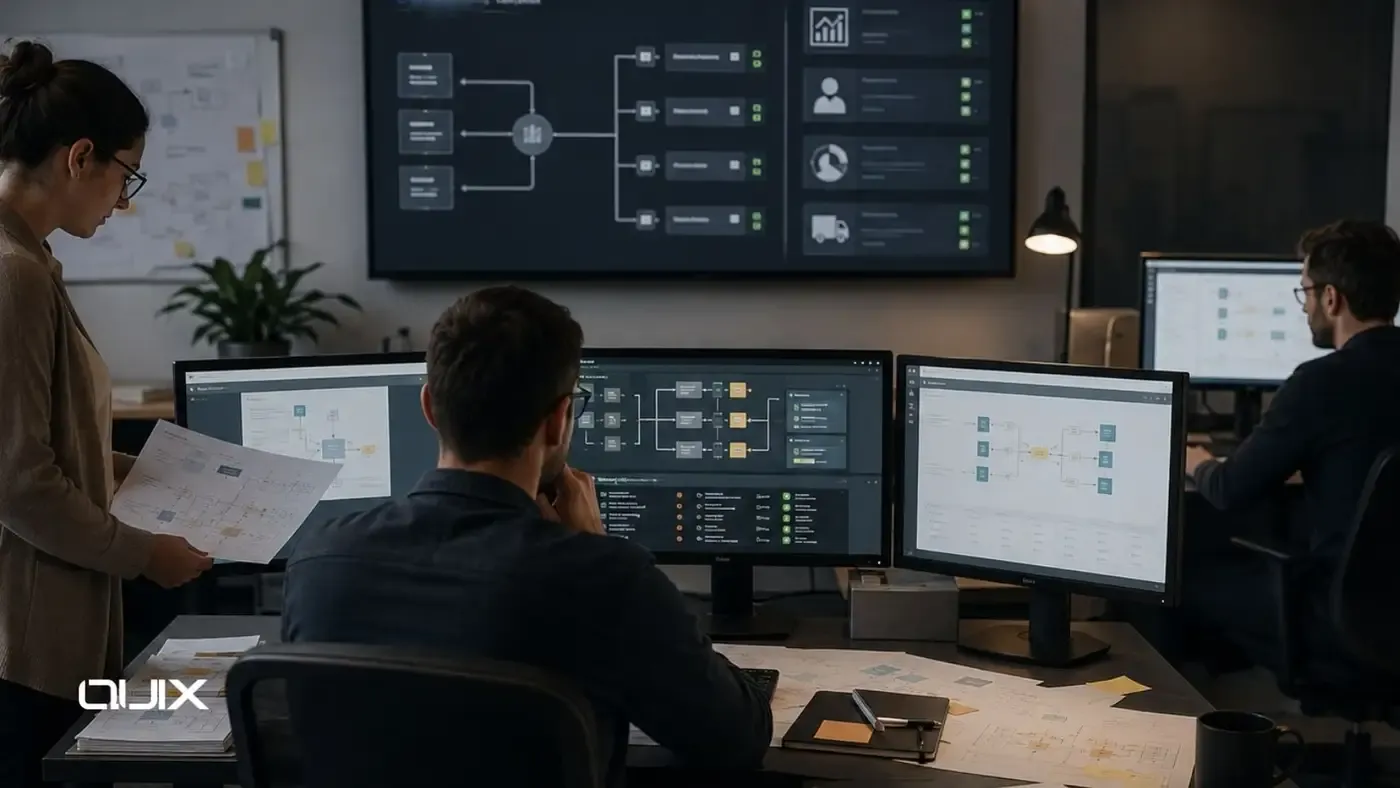
The integration pattern you choose today will define the cost and complexity of every system change you make for the next several years. This is not an exaggeration. It is the experience of organizations that build integrations without architecture.
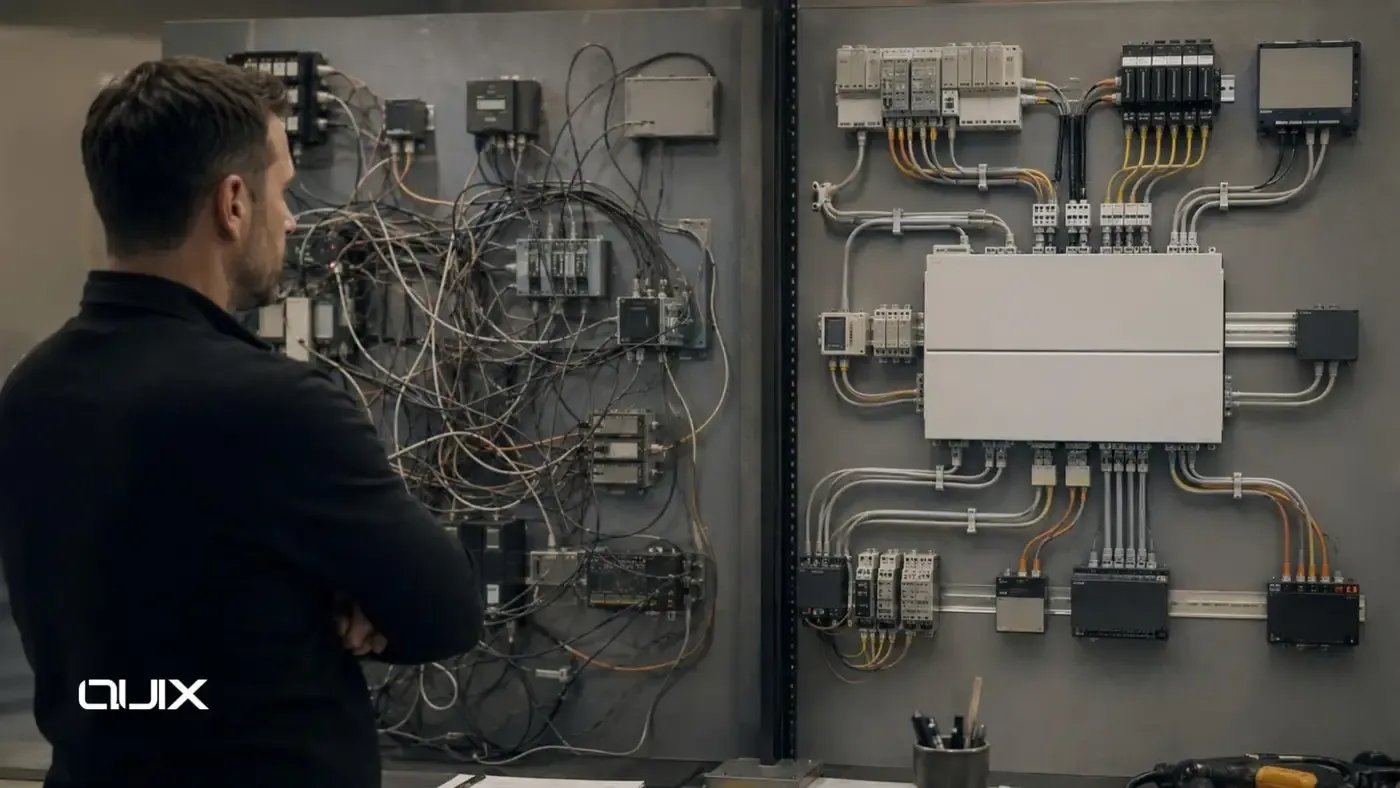
A network of point-to-point integrations that connects twenty systems with sixty custom connections becomes one of the most expensive architectural liabilities an enterprise can carry. Every system update requires assessing which connections it might break. Every new tool requires a new custom connection to every existing system it needs to communicate with. Every failure is difficult to diagnose because the integration logic is distributed across dozens of individually maintained code files.
Integration architecture prevents this by making the design of system connectivity an explicit architectural decision rather than a series of tactical responses to immediate problems.
Executive Summary
System integration architecture defines the patterns, principles, and infrastructure through which enterprise systems exchange data and coordinate actions. The choice of integration architecture affects scalability, maintainability, failure handling, observability, security, and the long-term cost of operating and evolving the system landscape.
This article covers the main integration architecture patterns — point-to-point, API-led, event-driven, middleware-based, and iPaaS — along with their respective strengths, risks, and appropriate use cases. It includes an architecture decision matrix and a best-practice checklist for enterprise integration design.
Core Integration Architecture Patterns
Point-to-Point Integration
Point-to-point integration connects two systems directly through a custom-built connection. The connection is specific to the data format and communication protocol of each system.
Point-to-point is fast to build for a single connection and appropriate for simple, stable, bilateral integrations between two systems that are unlikely to change or be replaced. It becomes problematic at scale. As the number of systems grows, the number of connections grows quadratically. Twenty systems can theoretically require up to one hundred and ninety point-to-point connections if full bilateral connectivity is needed. In practice, this creates a fragile, expensive-to-maintain architecture that resists change.
The primary risk is coupling. A change to one system's API, schema, or authentication model can break all connections that directly reference it.
API-Led Architecture
API-led architecture organizes integration around a layered API model. System APIs expose the core capabilities of each system. Process APIs orchestrate business workflows by composing system APIs. Experience APIs deliver tailored data to specific consumers — mobile apps, portals, analytics platforms, AI systems.
This layered approach reduces coupling by providing stable interfaces that can evolve independently from the underlying systems. When a backend system changes, only the system API layer requires updating — the process and experience APIs above it remain stable if the API contract is maintained.
API-led architecture is appropriate for organizations with complex integration requirements across many systems, where multiple consumers need to access similar data in different formats, and where the system landscape is expected to evolve over time.
Event-Driven Architecture
Event-driven architecture moves data and triggers actions in response to specific operational events rather than through direct request-response API calls. Systems publish events to a message broker or event stream. Subscribing systems consume the events they are interested in and take the appropriate action.
This approach decouples systems at the communication level. The system that generates an event does not need to know which systems will consume it or what they will do with it. This makes it significantly easier to add new consumers, change consumer behavior, or replace individual systems without affecting others.
Event-driven architecture is particularly well-suited to high-volume, real-time data flows and to AI and automation use cases where systems need to react immediately to operational events rather than polling for changes.
Middleware and Enterprise Service Bus
Middleware sits between systems and manages integration logic: routing messages to the correct destination, transforming data formats, applying business rules, handling failures, and providing a centralized integration governance layer.
Enterprise Service Bus (ESB) is a traditional middleware pattern that provides a central integration hub. It is appropriate for environments where central governance of integration logic is important, where complex transformation and routing rules need to be applied consistently, and where integration operations are managed by a dedicated platform team.
The risk of centralized middleware is that it can become a bottleneck and a single point of failure if not designed and operated with appropriate capacity and redundancy.
iPaaS (Integration Platform as a Service)
iPaaS platforms provide managed integration infrastructure with pre-built connectors for common enterprise applications, visual workflow design tools, monitoring, and governance features. They reduce the engineering effort required to build integrations for standard use cases.
iPaaS is appropriate for organizations that need to connect common enterprise platforms quickly, that have integration requirements within the capabilities of the available connectors, and that do not want to build and maintain custom integration infrastructure.
The limitations of iPaaS become apparent when integration requirements are complex, highly customized, or involve systems for which pre-built connectors are not available. In these cases, iPaaS can create abstraction that makes complex integrations harder to diagnose and maintain.
Integration Architecture Decision Matrix
Use this matrix to identify the most appropriate integration pattern for a given use case.
|
Pattern |
Best For |
Risk |
Scale Suitability |
|---|---|---|---|
|
Point-to-Point |
Simple, stable, bilateral integrations |
Quadratic connection growth at scale |
Low-Medium |
|
API-Led |
Complex landscapes with many consumers |
Higher initial design investment |
High |
|
Event-Driven |
Real-time flows, AI, automation triggers |
Message ordering and delivery complexity |
Very High |
|
Middleware/ESB |
Central governance, complex routing/transform |
Single point of failure risk |
Medium-High |
|
iPaaS |
Standard app integrations, rapid deployment |
Vendor lock-in, limited flexibility |
Medium |
Security in Integration Architecture
Integration architecture creates data pathways between systems, which means it also creates potential security vulnerabilities if not designed correctly. Security must be embedded in the integration architecture, not added as an afterthought.
Authentication and authorization at the integration layer defines which systems are allowed to call which APIs, what data they can access, and what actions they can trigger. This should use standardized protocols (OAuth 2.0, OpenID Connect, API keys with scoped permissions) rather than bespoke authentication schemes that are harder to audit and rotate.
Data in transit must be encrypted. Integration connections that carry sensitive business data — customer records, financial transactions, personal information — must use transport-layer encryption and, in high-sensitivity environments, payload-level encryption.
Audit logging at the integration layer records which systems accessed which data, what operations were performed, and when. This is essential for compliance, incident investigation, and the increasingly common requirement to demonstrate that AI systems accessed data within their authorized scope.
Observability and Failure Handling
Integration failures are inevitable. Systems go offline. APIs change without notice. Data arrives in unexpected formats. Message queues back up under load. The integration architecture that handles these failures gracefully is significantly more reliable than one that treats failure as an exception to be handled later.
Observability infrastructure for integration includes: real-time dashboards showing integration health, latency, and throughput; alerting that notifies operations teams when flows fail, delay, or produce unexpected outputs; logging that captures enough context to diagnose failures quickly; and dead-letter queues or equivalent mechanisms that capture failed messages for reprocessing after the root cause is resolved.
Failure handling design should be explicit about what happens at each failure point. A payment-initiated event that fails to reach the finance system needs a different failure response than a marketing analytics event that fails to reach the data warehouse. Designing failure responses in advance prevents the improvised responses that often create secondary problems when failures occur in production.
Integration Architecture Best-Practice Checklist
- Is the integration pattern selected based on the use case requirements, not vendor preference or familiarity?
- Are integration contracts (schemas, protocols, authentication) documented and version-controlled?
- Does the integration architecture support adding new consumers without rebuilding existing connections?
- Are authentication and authorization enforced at the integration layer for every data flow?
- Is all data in transit encrypted, particularly for sensitive business or personal data?
- Is there observability infrastructure with real-time monitoring, alerting, and logging?
- Is failure handling explicitly designed for each integration flow, with retry logic and fallback procedures?
- Are integration dependencies mapped so that changes to one system can be assessed for downstream impact?
- Is there a change management process for modifications to integration logic and API contracts?
- Is the integration architecture scalable to the transaction volume the business is expected to reach?
Common Integration Architecture Mistakes
Building integrations without an architecture decision is the most common and most expensive mistake. Each point-to-point connection built in isolation eventually contributes to a network of technical debt that resists change and amplifies failure.
Selecting an integration pattern before understanding the data volume, latency requirements, and consumer complexity of the use case frequently produces a mismatch between the pattern's characteristics and the business requirements it must support.
Neglecting failure handling design leads to integrations that work in normal conditions and fail silently or catastrophically under load, during system updates, or when upstream data quality degrades.
Treating integration as a solved problem after implementation is the mistake that turns maintainable integrations into technical debt over time. Integration requires ongoing monitoring, maintenance, and governance as the systems it connects continue to evolve.
FAQ
What is system integration architecture?
System integration architecture defines the patterns, principles, and infrastructure through which enterprise systems exchange data and coordinate actions. It determines how scalable, maintainable, and reliable the integration layer will be as the organization and its system landscape evolve.
What is the difference between API-led and event-driven integration?
API-led integration uses request-response API calls organized in layers (system, process, experience). Event-driven integration triggers data movement and actions in response to operational events through a message broker. API-led suits synchronous, request-based interactions; event-driven suits real-time, asynchronous, high-volume data flows.
When should enterprises use iPaaS?
iPaaS is appropriate when integration requirements match the capabilities of available pre-built connectors, when rapid deployment of standard integrations is the priority, and when the organization does not need to build and maintain custom integration infrastructure. It becomes limiting for highly complex, customized, or non-standard integration requirements.
Why is observability important in integration architecture?
Integration failures are inevitable. Observability — real-time monitoring, alerting, logging, and failure handling — determines how quickly failures are detected and resolved, and how confidently the organization can depend on integration as operational infrastructure.
What is the biggest risk of point-to-point integration?
The biggest risk is the quadratic growth in connection complexity as the number of systems increases. A network of point-to-point connections becomes collectively unmaintainable because every system change potentially affects many connections, and every new system requires new connections to every system it must communicate with.