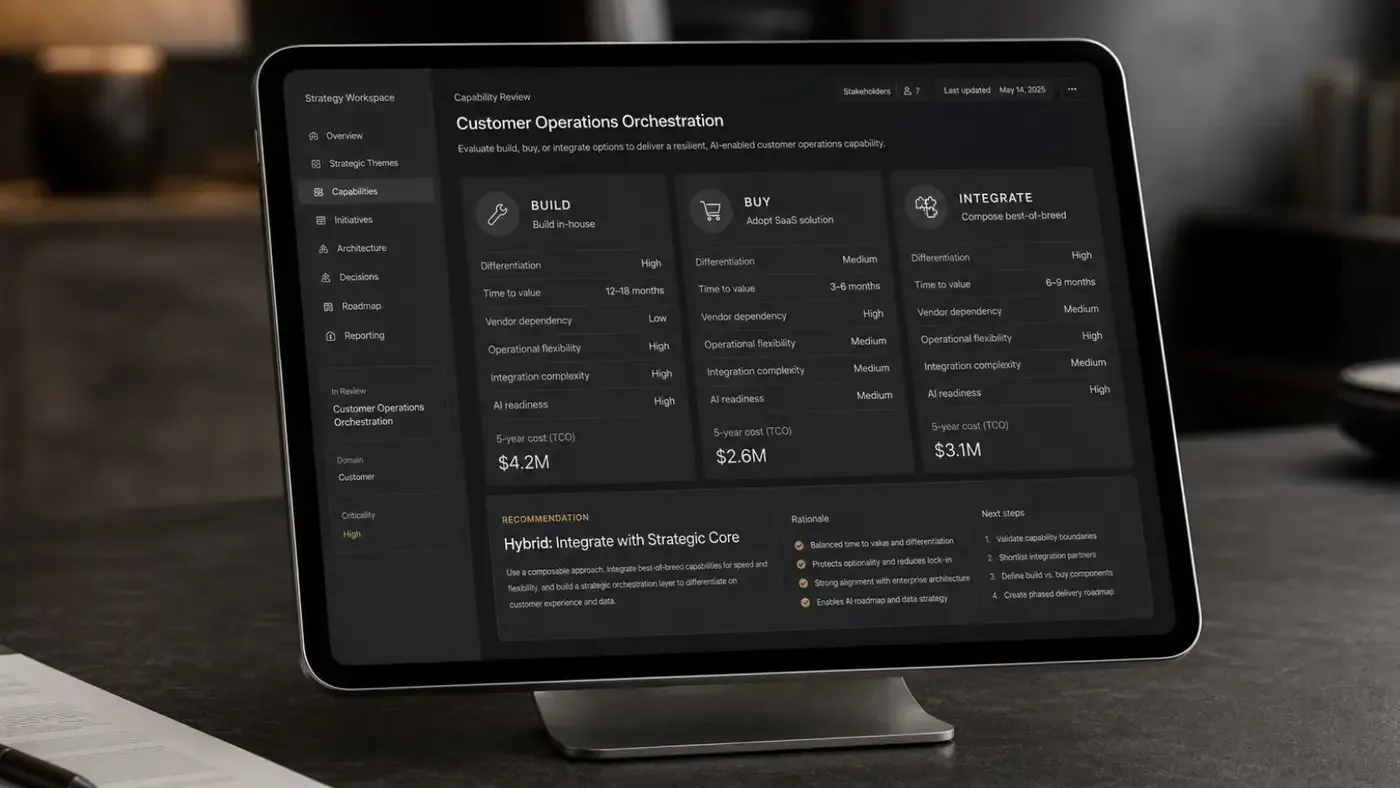
Every enterprise technology decision eventually reduces to one of three options: build it yourself, buy a platform that does it, or integrate what you already have into a configuration that does what you need.
Each option is right in a specific context and wrong in others. The organizations that consistently make the correct choice do so because they have defined the operating model requirements before they evaluate the options — not because they have a standing preference for custom software or a bias toward established platforms.
This article provides a structured framework for making the build vs buy vs integrate decision for enterprise systems, including a comparison matrix and a Quix recommendation model.
Executive Summary
The build vs buy vs integrate decision is not primarily a cost comparison. It is a strategic choice about capability ownership, operational flexibility, implementation risk, technical debt, and long-term scalability.
Build maximizes control and flexibility at the cost of time, investment, and ongoing engineering responsibility. Buy offers faster deployment and lower initial investment at the cost of configuration constraints and platform dependency. Integrate extends existing capabilities at the cost of integration complexity and potential architectural compromise.
The right answer depends on how differentiated the capability is, how mature the market is for commercial solutions, how complex the integration with existing systems would be, and how the choice affects AI readiness, scalability, and long-term operational control.
Why This Decision Is Harder Than It Appears
The build vs buy vs integrate question appears straightforward until it is evaluated against the specific requirements of a real enterprise. At that point, several complicating factors emerge.
The commercial platform that seems to cover ninety percent of requirements may miss the ten percent that represents the organization's most operationally critical or commercially differentiated workflows.
The custom build that offers complete control over the design also requires sustained engineering investment for maintenance, security, compliance updates, and feature development that organizations frequently underestimate.
The integration approach that preserves existing investment and avoids a full replacement may create an architecture that becomes more entangled and costly to maintain as the number of integrated systems grows.
None of these paths is inherently superior. Each is a tradeoff. The decision framework below is designed to make those tradeoffs explicit rather than leaving them to vendor preference or internal political pressure.
Understanding Each Strategy
Build: Custom Software Development
Building means commissioning or developing a custom software system designed specifically for the organization's operating requirements. The resulting system is owned by the organization and can be designed to match the operating model exactly.
Build is appropriate when the capability being built is a genuine source of competitive differentiation, when no commercial platform comes close to meeting the operational requirements, when the organization has the engineering capability to build and maintain a production system, or when the data architecture and integration requirements are so specific that adapting a commercial platform would cost more than building from scratch.
Build is inappropriate when a commercial platform already delivers ninety percent or more of the required functionality, when the organization does not have the sustained engineering capacity to own and evolve the system, or when the operational requirement is well-understood and stable rather than differentiating and evolving.
Buy: Commercial Platform Adoption
Buying means selecting and implementing a commercial platform that covers the functional requirements. The platform is configured, extended with available customization tools, and integrated with the organization's existing systems.
Buy is appropriate when the requirement is well-served by the market — CRM, ERP, HRIS, project management, support, analytics — and when the platform's standard capabilities cover the majority of what the organization needs.
Buy becomes problematic when the gaps between what the platform does and what the organization needs are filled with extensive customization that creates technical debt, slows future upgrades, and ultimately produces a system that behaves like custom software but carries the constraints of a commercial platform.
Integrate: Composition and Extension
Integrating means combining existing systems, commercial platforms, and custom components through integration layers, APIs, and middleware to deliver a capability that no single system provides alone.
Integrate is appropriate when the organization already has strong individual platforms that cover functional domains well, but needs them to work together as a coherent operational system. It is also appropriate when replacing any individual platform would create more disruption than value in the short term.
Integration strategy is increasingly the dominant model in modern enterprise architecture. Rather than choosing between monolithic commercial platforms and full custom builds, many enterprises compose their operating systems from specialized platforms connected by well-designed integration layers.
Build vs Buy vs Integrate: Decision Matrix
Evaluate each strategic option across the dimensions most relevant to long-term enterprise system success.
|
Dimension |
Build |
Buy |
Integrate |
|---|---|---|---|
|
Speed to value |
Slowest |
Fastest |
Medium |
|
Upfront investment |
Highest |
Medium |
Variable |
|
Ongoing cost |
Engineering + maintenance |
License + configuration |
Integration + management |
|
Operational flexibility |
Maximum |
Constrained by vendor |
Moderate |
|
Vendor dependency |
None |
High |
Distributed |
|
Technical debt risk |
Medium (if well-engineered) |
High (if over-customized) |
Medium-High (if undocumented) |
|
Data ownership |
Full |
Governed by vendor |
Distributed |
|
AI readiness |
Designed-in |
Depends on platform |
Designed through integration layer |
|
Integration complexity |
Designed from scratch |
Standard APIs available |
Core challenge of this path |
|
Security control |
Full |
Shared with vendor |
Distributed |
|
Scalability |
Designed to requirements |
Vendor-determined limits |
Architecture-dependent |
|
Upgrade path |
Controlled by organization |
Vendor-controlled |
Component-level independence |
The Quix Recommendation Framework
At Quix, we evaluate the build vs buy vs integrate question against four primary criteria: differentiation, maturity, integration complexity, and AI readiness.
|
If... |
Then... |
Rationale |
|---|---|---|
|
The capability is a genuine competitive differentiator |
Lean toward Build |
Ownership and control of differentiating capabilities protects competitive position |
|
A mature commercial platform covers ≥80% of requirements |
Lean toward Buy |
Standard market solutions reduce implementation risk and engineering overhead |
|
You have strong existing platforms with gaps between them |
Lean toward Integrate |
Integration extends existing investment and reduces transition risk |
|
The requirement spans multiple systems and domains |
Consider Integrate with custom components |
No single platform will cover cross-system requirements cleanly |
|
AI is a core use case |
Design AI readiness into the architecture first |
All three strategies can support AI — the architecture design determines the outcome |
|
Speed to production is critical |
Buy with clean configuration boundaries |
Commercial platforms deliver fastest initial capability with lower implementation risk |
|
Long-term cost of ownership is the primary constraint |
Model all three over a five-year horizon |
Build appears expensive upfront; Buy appears cheap until customization and license costs accumulate |
The Hidden Cost of the Wrong Choice
The most expensive enterprise system decisions are those that appear low-cost initially but accumulate structural debt over time.
Over-customized commercial platforms are the most common example. A company buys a platform for its speed and lower initial investment, then spends two to three years customizing it to fit operational requirements that the platform was not designed to support. The result is a system that behaves like custom software but cannot be upgraded cleanly, cannot be replaced without rewriting the customization layer, and has created lock-in deeper than the original platform license.
Poorly governed integration is the second most common accumulation of structural debt. An integration strategy that adds connections without architectural governance creates a growing network of dependencies that becomes increasingly fragile and expensive to maintain.
The correct framing for the build vs buy vs integrate decision is not "what is cheapest now?" but "what is the most operationally appropriate, architecturally sustainable, and strategically aligned choice for this specific capability in this specific context?"
AI Readiness and Strategy Choice
The build vs buy vs integrate decision has important implications for AI readiness. Enterprise AI depends on data accessibility, process structure, governance clarity, and integration depth.
Custom-built systems can be designed with AI readiness from the ground up: structured data models, event-driven architecture, API-first design, clean audit trails, and governance frameworks that define how AI can access and act on operational data.
Commercial platforms increasingly include AI capabilities, but those capabilities are constrained by the platform's data model and governance framework. Organizations that need AI to operate across multiple systems often find that platform-native AI does not cover the cross-functional use cases that create the most enterprise value.
Integration architecture creates the opportunity to build an AI layer above multiple specialized platforms, accessing structured data from each through well-designed integration contracts. This approach often produces the broadest AI coverage, but requires the most careful architectural design to implement reliably.
Common Strategic Mistakes
The most common mistake is making the build vs buy decision based on features rather than operating requirements. Feature comparisons favor commercial platforms for their breadth, but the relevant question is whether the platform's capabilities map to the operating model the organization needs to support, not simply whether the feature exists in the product.
A second mistake is evaluating cost over one to two years instead of five to seven. Custom builds look expensive at year one and competitive at year four. Commercial platform costs look low at year one and substantial at year four when license growth, customization debt, and integration maintenance are included.
A third mistake is treating the decision as binary. Most modern enterprise systems are composed solutions: a commercial ERP for financial processes, a specialized CRM for sales, a custom operations platform for differentiated workflows, an integration layer that connects them, and an AI layer that works across all of them.
A fourth mistake is making the decision without an architecture design. The build vs buy vs integrate question can only be answered correctly in the context of a defined operating model, data architecture, and integration design. Without this context, the decision is based on vendor preference, not strategic logic.
FAQ
How should enterprises decide between build, buy, and integrate?
The decision depends on capability differentiation, commercial platform maturity, integration complexity, AI readiness requirements, and long-term cost of ownership. It should be made in the context of a defined operating model and integration architecture, not based on features or initial cost alone.
When is building custom software the right enterprise strategy?
When the capability is a genuine competitive differentiator, when no commercial platform comes close to operational requirements, or when the data architecture and integration requirements are too specific for a commercial platform to accommodate without extensive customization.
What is the main risk of buying a commercial platform?
Over-customization. When the gaps between the platform's standard capabilities and the organization's requirements are filled through customization, the result is a system that behaves like custom software but carries the constraints of a commercial platform and cannot be upgraded cleanly.
When is integration the right system strategy?
When the organization has strong individual platforms that cover functional domains well, but needs them to work together as a coherent system. Also appropriate when replacing any individual platform would create more disruption than value in the short term.
How does the build vs buy vs integrate decision affect AI readiness?
All three strategies can support AI, but the architecture design determines the outcome. Custom builds can incorporate AI readiness from the ground up. Commercial platforms constrain AI to their data model. Integration architecture can create an AI layer above multiple platforms, which often produces the broadest enterprise AI coverage.