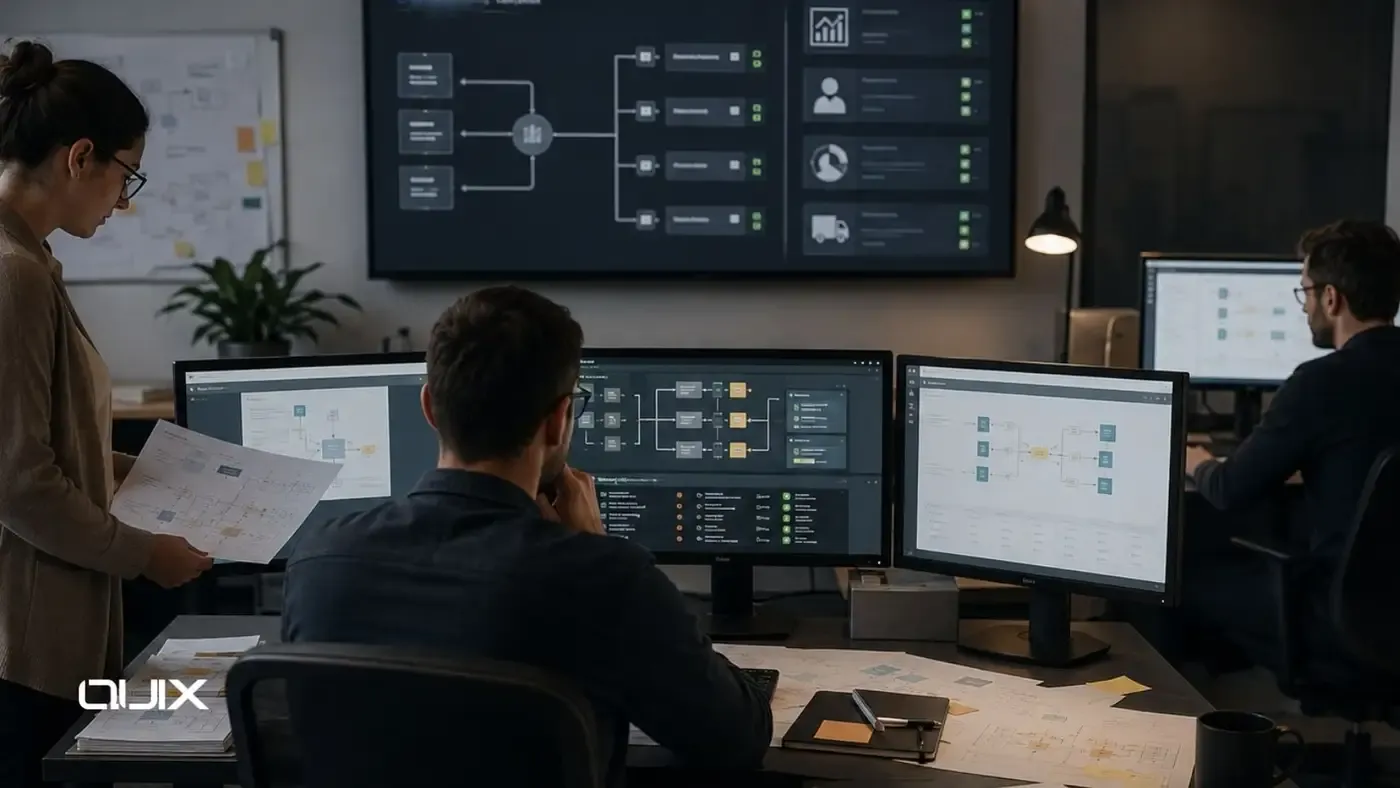
Most enterprise organizations do not have a technology stack. They have a technology accumulation. Tools were added as problems appeared, departments selected platforms independently, and no one was responsible for ensuring that the resulting collection of systems worked together as a coherent whole.
The difference between a technology accumulation and a connected technology stack is not the number or quality of the tools. It is the architecture that connects them: the defined data flows, the integration patterns, the governance model, the shared view of customers and operations, and the deliberate design of how each tool contributes to the overall operating model.
Executive Summary
A connected enterprise technology stack is a deliberately designed digital operating environment in which the tools used across the business share data reliably, coordinate workflows automatically, provide a consistent operational view to all functions, and support analytics and AI without requiring manual data assembly.
Building this requires moving through a structured approach: establishing systems of record, designing integration architecture, defining data flows, automating cross-system workflows, enabling unified reporting, and creating the governance model that maintains connectivity as the stack evolves.
This article explains how to approach this transition, what the key architectural components are, and how to sequence the work to deliver operational value at each stage without creating new complexity.
The Four Layers of a Connected Enterprise Stack
Systems of Record
Systems of record are the authoritative sources for specific data entities. The CRM is the system of record for customer and pipeline data. The ERP is the system of record for orders, inventory, and financial transactions. The HR platform is the system of record for employee data. Each data entity has one home — and other systems receive that data rather than independently maintaining their own version of it.
Establishing clear systems of record is the prerequisite for everything else in a connected stack. Without it, integration creates conflicts rather than resolving them, because there is no agreed authority to resolve disagreements between systems.
Systems of Engagement
Systems of engagement are the platforms through which teams and customers interact with business data. CRM, support platforms, project management tools, customer portals, internal dashboards, and mobile apps are all systems of engagement. They display and update data, but they receive their data from systems of record rather than independently managing it.
In a connected stack, systems of engagement display current data from the authoritative source. The support platform shows the customer's current account status from the CRM, not from its own independent copy that may be out of date.
Integration and Automation Layer
The integration layer is what connects systems of record to systems of engagement, and connects operational events in one system to workflow actions in another. It manages data synchronization, API connectivity, event-driven workflows, and the transformation logic that translates data between different system formats.
The automation layer sits on top of the integration layer and orchestrates multi-step workflows that span systems: contract signed in the CRM triggers project creation in the delivery platform, triggers notification to finance, triggers access provisioning in the internal portal. Each step is automated because the integration layer provides the data and event connectivity that automation requires.
Intelligence and Reporting Layer
The intelligence layer combines data from all systems of record into unified analytics, dashboards, and AI capabilities. This layer is only possible when the underlying systems share clean, current, consistently structured data through the integration layer.
In a connected stack, the intelligence layer provides a single operational picture that spans all functions: pipeline and revenue, delivery and operations, customer health, financial position, and workforce capacity — all available in a consistent, current form rather than assembled manually from separate reports.
The Connected Enterprise Stack Framework
|
Stack Component |
Design Responsibility |
Connection Requirement |
|---|---|---|
|
CRM (Customer System of Record) |
Customer data, pipeline, account history |
Feeds ERP, support, analytics, finance |
|
ERP (Operations System of Record) |
Orders, inventory, production, financial records |
Receives from CRM, feeds finance and analytics |
|
Finance Platform |
Invoices, payments, accounting, cost allocation |
Receives from ERP, feeds analytics and reporting |
|
HR/Workforce System |
Employee data, roles, capacity, payroll |
Feeds access management, analytics, operations |
|
Support Platform |
Customer cases, resolution data, satisfaction |
Reads from CRM, writes back resolved status |
|
Internal Tools and Portals |
Operational workflows, team coordination |
Reads from systems of record, triggers automation |
|
Data Warehouse / Analytics |
Cross-functional reporting and AI data supply |
Receives structured data from all systems of record |
A Practical Roadmap for Building a Connected Stack
Stage 1: Audit and Rationalize the Current Landscape
Before building connections, understand what exists. Inventory all tools in active use, identify redundant platforms, and map the informal data flows that currently bridge disconnected systems. This audit reveals both the integration gaps and the shadow systems that have emerged to compensate for them.
Stage 2: Define Systems of Record
For each major data entity — customer, contract, order, invoice, employee, product — designate the system of record. Document this formally and communicate it across the organization. This decision governs every subsequent integration design decision.
Stage 3: Design the Integration Architecture
Design the integration layer that will connect systems of record to systems of engagement. Choose integration patterns appropriate to each flow: real-time API or event-driven for time-sensitive operational data, scheduled sync for lower-frequency reference data. Define error handling, governance, and observability requirements.
Stage 4: Implement Core Integrations in Priority Order
Implement integrations starting with the highest-value, most disruptive data flows. Typically this means CRM-to-ERP for customer and order data, ERP-to-finance for financial data, and support-to-CRM for customer health data. Validate each integration before building the next layer.
Stage 5: Automate Cross-System Workflows
Once core data flows are established, build the workflow automations that coordinate actions across systems in response to operational events. Start with the workflows that currently require the most manual steps and the ones where errors are most costly.
Stage 6: Enable Unified Intelligence
Build the analytics and reporting layer that draws from all connected systems of record. Design dashboards that reflect the operational picture leadership needs without requiring manual report preparation. Introduce AI use cases on top of the trusted, structured data the connected stack provides.
Connecting Without Creating Complexity
The risk in building a connected stack is replacing one form of complexity — disconnected tools — with a different form — an overengineered integration layer that is difficult to maintain and understand.
The principle that prevents this is designing connections around operational needs rather than technical capability. Connect systems because a specific operational workflow requires data to flow between them. Do not connect systems because the technical capability to do so exists. Every connection that serves a documented operational need is a value-adding integration. Every connection that does not can be deferred or avoided.
Governance is the discipline that maintains this principle over time. As the stack evolves and new tools are added, governance ensures that each new connection is evaluated against the same standard: does this connection serve a specific operational requirement, and is it designed to be maintainable and observable?
FAQ
What is a connected enterprise technology stack?
A connected enterprise technology stack is a deliberately designed digital operating environment where tools share data reliably, coordinate workflows automatically, and provide a consistent operational view across all business functions — rather than operating as disconnected silos.
What is the difference between a system of record and a system of engagement?
A system of record is the authoritative source for a specific data entity. A system of engagement is a platform through which teams interact with that data. Systems of engagement receive data from systems of record rather than independently maintaining their own versions.
Why must systems of record be defined before integration is built?
Without defined systems of record, integration creates data conflicts: two systems each claiming authority over the same entity will overwrite each other's data on every synchronization cycle. Systems of record establish which system wins and which system receives.
How do you avoid creating new complexity when connecting enterprise tools?
Design connections around documented operational needs rather than technical capability. Every integration should serve a specific workflow requirement. Governance that evaluates each new connection against this standard prevents the accumulation of unnecessary integrations that add maintenance cost without operational value.
What is the correct sequence for building a connected enterprise stack?
Audit the current landscape, define systems of record, design integration architecture, implement core integrations in priority order, automate cross-system workflows, then enable unified analytics and AI. Skipping the early design stages produces integrations that require rework as the stack scales.