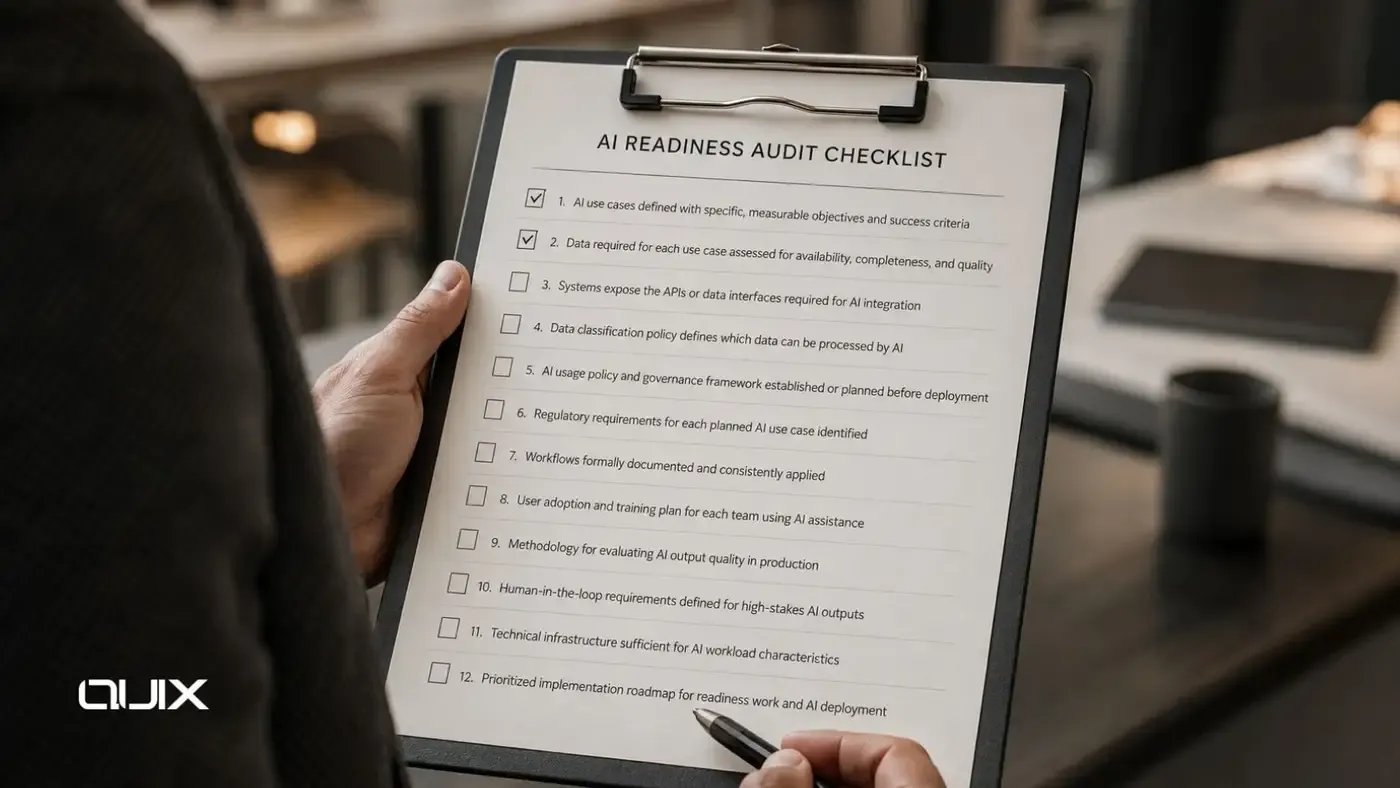
Enterprise AI programs that fail consistently share a common characteristic: they begin with model selection and end with a discovery that the underlying systems, data, and governance are not ready to support production AI. An AI readiness audit inverts this sequence — assessing readiness before investment is committed, so that the gaps revealed by the audit become a preparation roadmap rather than a production failure.
The audit is not primarily a technology assessment. It is an operational assessment: whether the organization's systems, data, processes, governance, and people are in a state that allows AI to function reliably and safely in production — and where the most consequential gaps are that must be addressed before meaningful AI deployment is attempted.
Executive Summary
An enterprise AI readiness audit evaluates twelve dimensions: business use case clarity, data availability and quality, system integration readiness, security and access control, governance framework, compliance alignment, workflow readiness, user adoption capacity, model evaluation capability, risk controls, technical infrastructure, and implementation roadmap maturity.
The audit produces two outputs: a readiness score across each dimension that identifies where the organization is AI-ready and where foundational work is required, and a prioritized preparation roadmap that sequences the readiness-building work in the order that creates the conditions for the highest-value AI use cases as quickly as possible.
The Twelve Readiness Dimensions
1. Business Use Case Clarity
Before any technical assessment, the organization must have specific, measurable AI use cases defined. Not "we want to use AI to improve operations" but "we want to reduce invoice processing time from five days to same day using AI extraction and automated approval routing for invoices below ten thousand dollars."
Use case clarity determines everything downstream: which data is needed, which systems must be integrated, what governance must be established, and how success will be measured. Without it, the readiness audit has no target to assess readiness against.
2. Data Availability and Quality
For each defined use case, assess whether the data required by the AI solution is available, accessible, and of sufficient quality. This means: data profiling for completeness rates, consistency across sources, freshness, format standardization, and the presence of the specific fields or document types the AI will need.
The data assessment should also map data ownership — which systems are the sources of truth for the data the AI needs, and whether access to those systems can be granted to the AI integration layer with appropriate permission controls.
3. System Integration Readiness
AI solutions almost always require integration with existing enterprise systems: CRM, ERP, document stores, support platforms, data warehouses. Integration readiness assesses whether those systems expose the APIs, webhooks, or data export mechanisms required for AI integration, whether the integration architecture is designed to support AI workload patterns, and whether the data contracts between systems are stable enough to rely on.
4. Security and Access Control
AI readiness from a security perspective requires: a data classification framework that determines which data can be processed by AI under which conditions, a permission model that can be extended to AI system identities, an authentication mechanism for AI API integrations, and audit logging capability for AI data access.
Security gaps discovered during AI deployment — rather than before it — create compliance remediation work that is more disruptive and expensive than preventive security design.
5. Governance Framework
Governance readiness assesses whether the organization has (or can rapidly establish): an AI usage policy, oversight level definitions for different AI use cases, an audit trail requirement, a process for detecting and responding to AI quality degradation, and a vendor governance framework for externally provided AI components.
6. Compliance Alignment
For each planned AI use case, identify the regulatory frameworks that govern the data processed and the decisions supported: GDPR for EU personal data, sector-specific regulations for financial services or healthcare, and any contractual obligations that govern the use of customer data. Each regulation may impose specific requirements on the AI system design.
7. Workflow Readiness
AI integration requires documented, consistently applied workflows — the same prerequisite that any automation requires. Workflow readiness assesses whether the processes AI will participate in are formally defined, consistently followed, and stable enough for AI integration to produce consistent results.
8. User Adoption Capacity
AI that users do not trust or do not know how to work with does not produce operational value. Adoption capacity assesses organizational willingness to adopt AI assistance, any previous AI adoption experiences that have shaped user attitudes, the training and change management capacity to support AI rollout, and the presence of potential internal champions.
9. Model Evaluation Capability
Production AI requires ongoing quality evaluation. Evaluation readiness assesses whether the organization can define accurate quality criteria for each AI use case, whether a labeled evaluation dataset can be created or assembled, and whether there is technical capability to run evaluation methodically and interpret results.
10. Risk Controls
Risk control readiness assesses whether the organization has defined human-in-the-loop requirements for each planned AI use case, whether there are rollback and remediation procedures for AI quality failures, and whether the risk appetite for AI errors is calibrated appropriately to the actual consequences of those errors in production.
11. Technical Infrastructure
Infrastructure readiness assesses whether the technical environment can support AI workload characteristics: API latency requirements, concurrent request volumes, storage for model artifacts and AI-generated content, compute resources for any on-premise components, and integration with the monitoring infrastructure that AI requires.
12. Implementation Roadmap Maturity
Roadmap maturity assesses whether the organization has a realistic, dependency-sequenced plan for building AI readiness and deploying AI use cases: which readiness gaps must be closed first, which AI use cases can proceed in parallel once foundation work is complete, and what the realistic timeline looks like given current organizational capacity.
AI Readiness Scoring Model
|
Readiness Score |
Dimension Status |
Recommended Action |
|---|---|---|
|
Ready (3) |
Dimension requirements fully met for target use cases |
Proceed — no blocking work required |
|
Partial (2) |
Dimension requirements partially met — gaps are known |
Remediate specific gaps before AI deployment in this area |
|
Not Ready (1) |
Dimension requirements not met — foundational work required |
Address before any AI deployment that depends on this dimension |
|
Not Assessed (0) |
Dimension has not been evaluated |
Assess before roadmap is finalized |
AI Readiness Checklist
- Are AI use cases defined with specific, measurable objectives and success criteria?
- Has the data required for each use case been assessed for availability, completeness, and quality?
- Do the systems the AI must integrate with expose the APIs or data interfaces required?
- Is there a data classification policy that defines which data can be processed by AI?
- Is there an AI usage policy and governance framework, or is there a plan to establish one before deployment?
- Have regulatory requirements for each planned AI use case been identified?
- Are the workflows AI will participate in formally documented and consistently applied?
- Is there a user adoption and training plan for each team that will use AI assistance?
- Is there a methodology for evaluating AI output quality in production?
- Are human-in-the-loop requirements defined for high-stakes AI outputs?
- Is the technical infrastructure sufficient for AI workload characteristics?
- Is there a prioritized implementation roadmap that sequences readiness work and AI deployment?
FAQ
What is an enterprise AI readiness audit?
An enterprise AI readiness audit evaluates whether an organization's systems, data, governance, processes, and people are in a state that allows AI to function reliably and safely in production — across twelve dimensions from business use case clarity through technical infrastructure and implementation roadmap maturity.
Why must AI use cases be defined before the audit begins?
Readiness is always relative to a specific use case and its requirements. "We want to use AI" has no readiness criteria. "We want to use AI for invoice extraction with automated approval routing" has specific data, system, governance, and integration requirements that can be assessed against the current organizational state.
What is the output of an AI readiness audit?
Two outputs: a readiness score across each dimension that identifies where the organization is AI-ready and where foundational work is required, and a prioritized preparation roadmap that sequences readiness-building work in the order that creates conditions for the highest-value AI use cases as quickly as possible.
What is the most common AI readiness gap found in enterprise organizations?
Data quality and availability. Organizations frequently discover during readiness assessment that the data required for their target AI use cases is incomplete, inconsistently structured, or insufficiently accessible — requiring data governance and integration work before AI deployment can proceed.
How long does an AI readiness audit take?
For a focused readiness assessment covering two to four specific use cases, typically two to four weeks. Broader organizational AI readiness assessments covering multiple use cases and functions may require six to eight weeks. The timeline is primarily driven by stakeholder access and data profiling scope.