The organizations that have achieved genuine enterprise AI transformation — not a collection of experiments, but AI embedded as a reliable operational capability across the business — share a consistent approach. They did not start with models. They started with architecture.
Before any model was selected, they mapped the operational workflows AI would participate in. Before any data was provided to an AI system, they established data ownership, quality standards, and access governance. Before any AI was deployed, they defined the human oversight requirements and the audit trail. Before any AI was expanded, they validated that the production deployment was working as designed.
The Quix Framework for Enterprise AI Transformation codifies this approach into a structured, phased methodology. It is the methodology Quix uses to help enterprises move from AI ambition to AI production — without the security incidents, accuracy failures, and adoption disappointments that characterize less structured approaches.
Executive Summary
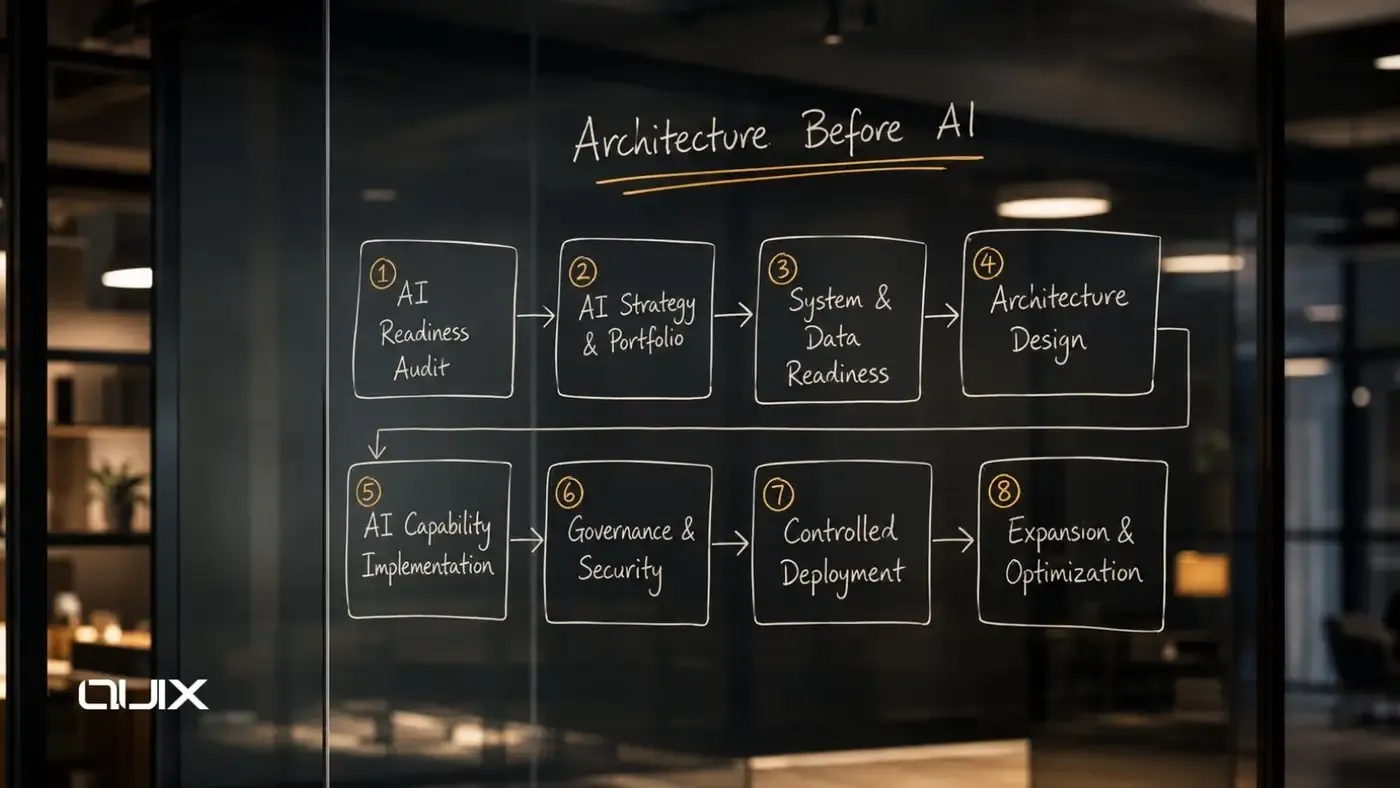
The Quix Enterprise AI Transformation Framework is an eight-phase methodology that moves organizations from AI readiness assessment through strategy and use-case portfolio design, system and data readiness preparation, architecture design, AI capability implementation, governance and security establishment, operational deployment, and continuous optimization.
The framework is built on a core conviction that is central to every Quix engagement: AI only works when the enterprise architecture is ready. This means designing the system first — the data flows, the integration architecture, the permission model, the process design — and deploying AI as the final layer on top of a prepared operational foundation, not as the first layer on top of an unprepared one.
The Quix AI Principle: Architecture Before AI
Quix designs enterprise systems before we choose AI tools. This principle, which also governs our enterprise system design and integration practice, applies with particular force to AI transformation.
The temptation in enterprise AI programs is to select the AI tool first and then figure out the data, integration, and governance. This sequence consistently produces the same failure: an AI capability that works in the proof of concept and fails in production because the operational conditions of production — variable data quality, permission boundaries, workflow edge cases, concurrent system load — were not present in the controlled environment where the AI was developed.
Architecture-first AI transformation designs the operational conditions first, then deploys AI into them. When this sequence is followed, the AI encounters the same conditions in production that it was designed and validated against — and it performs accordingly.
The Eight Phases of the Quix Enterprise AI Transformation Framework
Phase 1: AI Readiness Audit
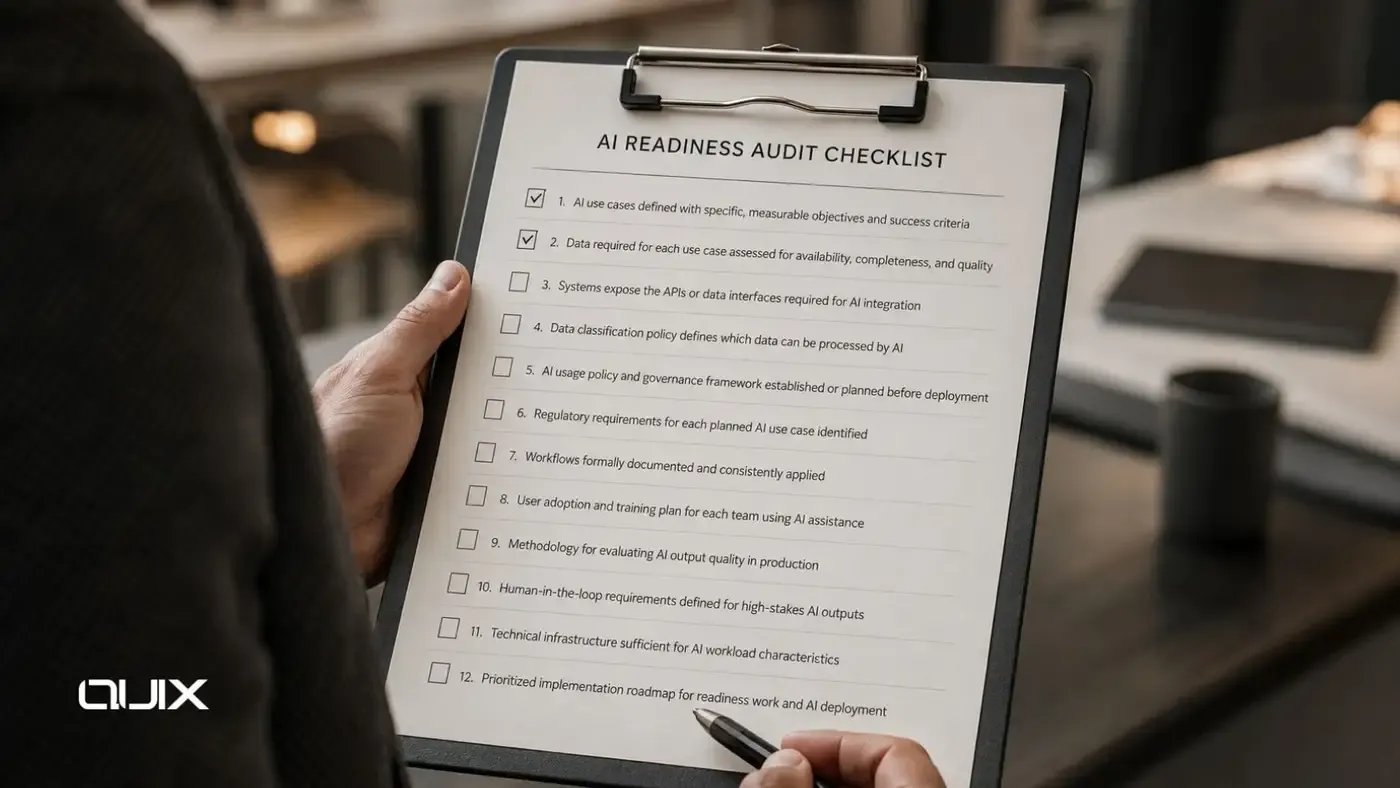
The Quix AI transformation engagement begins with a structured readiness audit across twelve dimensions: business use case clarity, data availability and quality, system integration readiness, security and access control, governance framework, compliance alignment, workflow readiness, user adoption capacity, model evaluation capability, risk controls, technical infrastructure, and implementation roadmap maturity.
The audit produces a readiness score for each dimension and a prioritized preparation roadmap. This roadmap becomes the plan for Phase 2 — foundational readiness-building — and informs which AI use cases can begin implementation earliest and which must wait for foundational work to complete.
Phase 2: AI Strategy and Use-Case Portfolio
With the readiness audit complete, Quix works with the client organization to build the AI strategy: a prioritized portfolio of use cases, sequenced by business impact, organizational readiness, and AI fit; a deployment model decision for each use case (managed enterprise API vs private infrastructure vs hybrid); governance policy design; and the success metrics that will be used to evaluate production performance.
Use-case portfolio design is not a wishlist. It is a strategic prioritization exercise that considers which use cases deliver the most operational value in the shortest timeline given current organizational readiness, and which foundational investments enable the most high-value use cases to proceed.
Phase 3: System and Data Readiness
Phase 3 closes the readiness gaps identified in the audit. This work varies by organization but typically includes: data quality improvement for the data required by priority use cases, integration architecture design and implementation to make operational data accessible to AI systems, access control extension to accommodate AI system identities, workflow documentation and standardization for processes AI will participate in, and governance policy documentation and communication.
This phase is where enterprise AI programs most often stall when approached without a structured framework. The technical AI work cannot proceed reliably until the foundational readiness work is complete. Quix treats this as a distinct, resourced phase — not a checklist that the AI development team is expected to complete in parallel with model development.
Phase 4: Architecture Design
Architecture design specifies the technical structure of each planned AI capability: the integration layer, the retrieval pipeline (for RAG-based systems), the prompt orchestration design, the tool definitions and access controls (for agent-based systems), the output handling and human-in-the-loop design, the monitoring infrastructure, and the deployment model.
Architecture review is conducted independently — by someone who was not involved in the architecture design — before any implementation work begins. This catches architectural decisions that the design team has normalized to but that an objective review identifies as security risks, scalability constraints, or governance gaps.
Phase 5: AI Capability Implementation
Implementation builds each AI capability against the architecture design: the integration layer connecting AI components to enterprise systems, the retrieval pipeline for knowledge-grounded use cases, the workflow automation logic for process automation use cases, the agent orchestration and tool definitions for agentic use cases, and the document processing pipeline for document automation use cases.
Implementation proceeds in phases mapped to use-case priority and dependency. Foundation capabilities — integration layers, retrieval pipelines, permission architecture — are built before the AI capabilities that depend on them. Each capability is unit-tested before it is assembled into the end-to-end solution.
Phase 6: Governance and Security Establishment
Governance establishment implements the governance policies designed in Phase 2 as operational controls: access control configuration for AI system identities, audit logging infrastructure, human-in-the-loop workflow design and implementation, model evaluation framework with test set creation, and vendor governance documentation.
Security review is conducted before any AI capability is exposed to production data or production users. The review covers: authentication and authorization for all AI integration points, data boundary enforcement, audit log completeness, and assessment of the permission scope for each AI system identity against the least-privilege principle.
Phase 7: Controlled Deployment and Validation
Deployment begins with a controlled group — a specific team, a defined use case scope, a limited user population — that operates the AI capability in production conditions with full monitoring and human oversight. This is not a pilot in the conventional sense: it is production deployment at limited scale, with the full production architecture in place.
The controlled deployment period validates production performance against the accuracy and operational metrics defined in Phase 2. It identifies edge cases, performance characteristics, and user behavior patterns that did not appear in pre-production testing. It establishes the production baselines against which subsequent expansion will be compared.
Phase 8: Expansion and Continuous Optimization
When controlled deployment metrics indicate that the AI capability is performing as designed, expansion proceeds: additional user groups, additional use cases, higher automation thresholds based on validated production accuracy. Expansion is not automatic — each expansion is evaluated against the readiness criteria established for that phase of deployment.
Continuous optimization is the ongoing management of the AI transformation portfolio: monitoring production AI performance against established baselines, evaluating and retraining models that show accuracy drift, refining workflows based on production usage patterns, expanding governance as new use cases are added, and identifying the next tier of AI use cases for the portfolio.
The Quix Framework at a Glance
|
Phase |
Primary Focus |
Key Output |
|---|---|---|
|
Assess current state across 12 dimensions |
Readiness scores and preparation roadmap |
|
Define use cases, deployment model, governance, metrics |
AI strategy document and prioritized use-case portfolio |
|
Close foundational readiness gaps |
AI-ready data, integration, access controls, workflows |
|
Design AI capability architecture with independent review |
Architecture specification per use case |
|
Build AI capabilities against architecture specification |
Tested AI components ready for governance review |
|
Implement governance controls and security review |
Production-ready governance and security posture |
|
Validate in production at limited scale with full monitoring |
Production performance baselines and validation report |
|
Scale validated capabilities, optimize continuously |
Expanding AI portfolio with ongoing quality management |
What Makes the Quix Approach Different
Two things distinguish the Quix approach to enterprise AI transformation from the typical pattern of AI investment.
The first is the treatment of foundational readiness as a prerequisite, not a parallel track. Most AI programs attempt to build AI capability and address foundational readiness simultaneously — which produces AI capabilities that are technically developed but cannot be deployed because the data, integration, or governance is not ready. Quix separates the phases: foundational readiness is completed before AI capability implementation begins. This adds a few weeks at the front of the program and removes months of delay at the back.
The second is the integration of AI transformation with enterprise system design and integration. Quix brings the same discipline to AI architecture that it applies to enterprise system design and integration. The AI capability is not designed as a standalone system — it is designed as a component of the enterprise operating model, with the same rigor applied to its data access, integration patterns, permission design, and observability that governs the rest of the enterprise architecture.
FAQ
What is the Quix Enterprise AI Transformation Framework?
It is an eight-phase methodology that moves organizations from AI readiness audit through strategy and use-case design, system and data readiness preparation, architecture design, AI capability implementation, governance and security establishment, controlled deployment, and continuous optimization — designed to produce operational AI systems rather than isolated experiments.
What does "architecture before AI" mean in the Quix framework?
It means the enterprise system architecture — data flows, integration design, permission model, process documentation — is designed and made AI-ready before AI capabilities are built. AI is then deployed as the final layer on a prepared operational foundation, not as the first layer on an unprepared one. This sequence prevents the most common enterprise AI failure: capabilities that work in controlled environments and fail in production.
Why is foundational readiness a separate phase rather than a parallel track?
AI capabilities developed in parallel with foundational readiness work are built against preparation assumptions that may not match what the readiness work actually produces. This creates rework when the AI capability is developed against assumptions about data quality or integration access that the foundational work reveals are incorrect. Sequential phases eliminate this class of rework.
What is the controlled deployment phase?
The controlled deployment phase is production deployment at limited scale — a specific team, a defined use case scope, a limited user population — with the full production architecture in place and full monitoring active. It is distinct from a pilot in that the architecture is production-grade; it is limited only in scope. It establishes production baselines before expansion proceeds.
How does the Quix AI framework connect to enterprise system design and integration?
Quix designs AI capabilities as components of the enterprise operating model, not as standalone systems. The AI architecture uses the same integration patterns, permission design, data governance, and observability standards that govern the rest of the enterprise architecture. This integration ensures that AI scales with the enterprise system rather than creating a parallel, ungoverned capability layer.