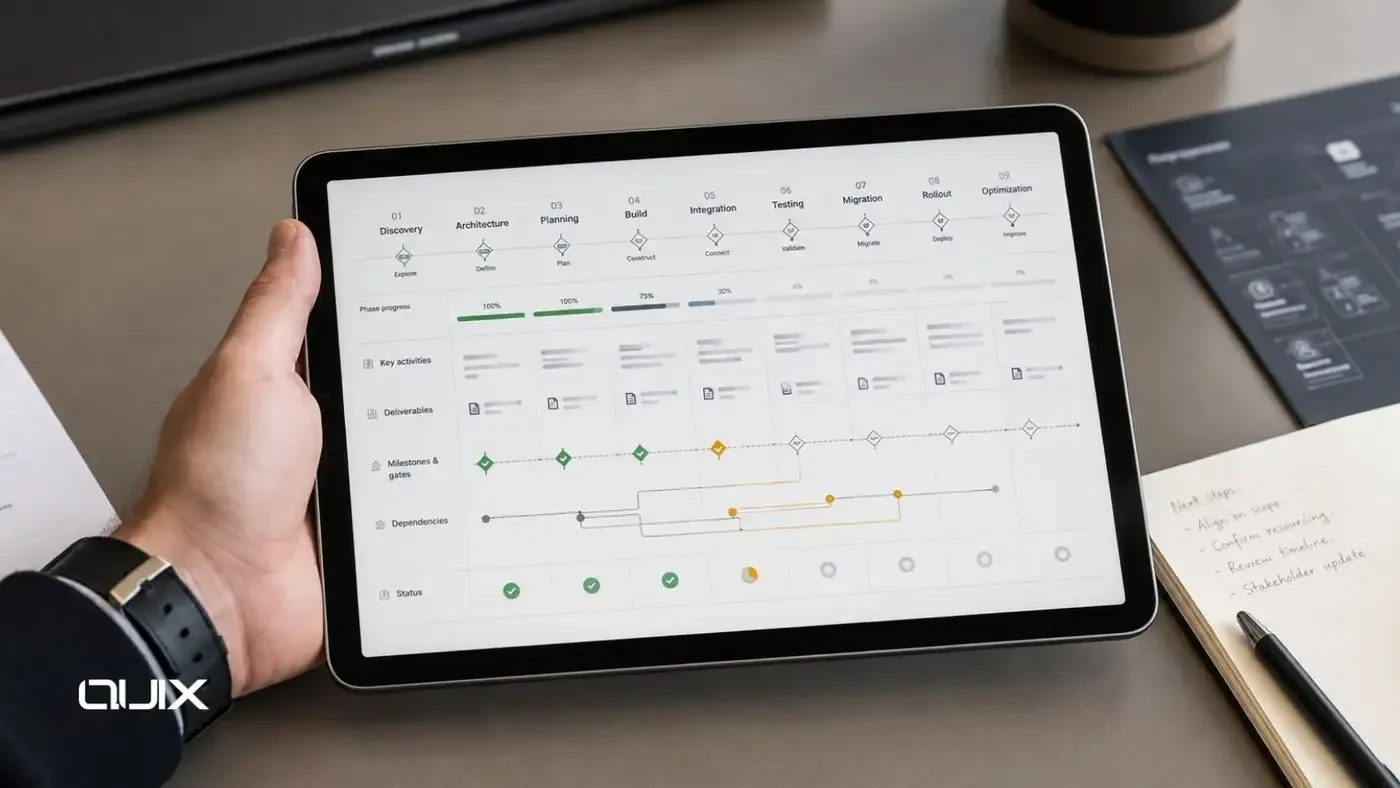
A project plan lists tasks and dates. An implementation roadmap defines the decisions that must be made at each stage, the risks that must be controlled, the dependencies that determine sequencing, and the measurable outcomes that confirm each phase is complete before the next begins.
The difference between a project plan and an implementation roadmap is the difference between activity tracking and decision management. Enterprise implementations fail when they have excellent task lists and poor decision gates: when teams are executing against a plan that no longer reflects the operational reality, when risks accumulate without being surfaced, and when the definition of done shifts without being formally acknowledged.
Executive Summary
An enterprise implementation roadmap is a structured, phase-gated delivery plan that sequences implementation work by dependency and risk, defines explicit decision gates between phases, establishes measurable outcomes for each phase, and provides the governance structure that keeps the implementation aligned with its business objectives through the inevitably changing conditions of a complex project.
This article provides a phase-by-phase implementation roadmap framework, explains what each phase must produce to be considered complete, identifies the decision gates that govern transitions between phases, and provides a planning checklist that helps implementation teams assess their readiness before each phase begins.
The Phase-by-Phase Implementation Roadmap
Phase 1: Discovery
Discovery maps the operational reality that the implementation must support. This includes stakeholder interviews across every function that will use or be affected by the system, workflow mapping of current processes, system and data audit, integration dependency identification, and success metric definition.
Discovery is complete when there is a validated requirements document that reflects the operational requirements of all stakeholders, a current-state process map, a list of integration dependencies with technical assessment, and a set of agreed success metrics that will be used to evaluate the implementation after go-live.
The decision gate at the end of discovery: Can we proceed to architecture with a clear, stakeholder-validated requirements document? If not, discovery must continue.
Phase 2: Architecture and Solution Design
Architecture translates discovery requirements into a technical design: the system configuration approach, data model, integration architecture, security and access control design, and testing strategy.
The architecture phase should produce a solution design document that the implementation team will reference throughout build. It should also identify the technical risks that are most likely to create delays: integration complexity, data migration scope, custom development requirements, or dependencies on third-party systems that have variable timelines.
Decision gate: Is the architecture technically validated, stakeholder-reviewed, and documented with sufficient detail to guide the build phase without requiring significant architectural decisions during build?
Phase 3: Implementation Planning
Implementation planning converts the architecture into a project plan with tasks, dependencies, owners, timelines, and risk controls. This phase produces the roadmap artifact itself: the phase-by-phase delivery plan that the project will execute against.
The most important output of this phase is a realistic timeline. Realistic timelines account for integration development complexity, data migration preparation time, testing iterations, change management preparation, and the inevitable friction of working with external systems and vendors. Timelines that assume everything will go as planned consistently produce late implementations.
Decision gate: Is there a timeline that accounts for realistic risk scenarios and includes adequate contingency? Has the governance model for managing scope changes been agreed by all stakeholders?
Phase 4: Build and Configuration
Build and configuration implements the solution design: platform configuration, workflow definition, permission structure, reporting design, and any custom development required for requirements that the platform cannot address through standard configuration.
The primary governance challenge during build is scope control. Stakeholders who see the system taking shape during build frequently generate additional requirements that were not captured in discovery. A defined scope change process — with impact assessment on timeline, cost, and other in-flight work before any change is accepted — is essential.
Decision gate: Are all in-scope requirements implemented and internally reviewed? Is the system ready for integration and QA phases?
Phase 5: Integration Build
Integration build connects the new system to the other platforms in the enterprise landscape. This work must be sequenced: integrations that other integrations depend on must be built and validated first. Each integration should be tested in isolation before being incorporated into end-to-end workflow tests.
Integration build is where implementations most commonly exceed their timeline estimates. External system dependencies, API documentation gaps, data format mismatches, and performance characteristics under load all introduce complexity that is difficult to fully anticipate during planning.
Decision gate: Are all integrations implemented, unit-tested, and validated against the integration specifications from the architecture phase?
Phase 6: Quality Assurance and Testing
QA encompasses functional testing, integration testing, performance testing, security testing, and user acceptance testing. Each testing type addresses a different dimension of implementation quality.
Functional testing validates that configured workflows, permissions, and reporting work as designed. Integration testing validates that data flows correctly between connected systems. Performance testing validates that the system handles realistic transaction volumes within acceptable latency. Security testing validates that access controls, encryption, and audit requirements are correctly implemented. User acceptance testing validates that real users can use the system effectively for their actual work.
Decision gate: Have all test types been completed? Have UAT findings been reviewed and resolved or formally accepted? Is there a documented list of known issues with a remediation plan?
Phase 7: Data Migration
Data migration moves historical data from legacy systems into the new solution. The migration plan should include a data profiling report that identifies quality issues in the source data, migration rule documentation that defines how each data entity and field maps to the new system, at least one test migration run with validation reporting, a cut-over migration plan with timing, dependencies, and rollback procedure.
Decision gate: Has the test migration been completed and validated? Is there a cut-over plan approved by all stakeholders? Is there a rollback plan if cut-over migration produces unexpected results?
Phase 8: Rollout
Rollout is the transition from implementation to production operation. The rollout plan defines how users will transition to the new system: whether through a hard cutover (all users switch on a specific date), a phased rollout (user groups transition sequentially), or a parallel run (old and new systems run simultaneously for a validation period).
Each rollout approach has a different risk profile. Hard cutover is faster but higher risk. Parallel run is lower risk but operationally expensive. Phased rollout provides a middle path for organizations that have the ability to segment users meaningfully.
Decision gate: Have all pre-go-live criteria been validated? Is the rollback plan approved and understood? Are support and monitoring resources in place for the go-live period?
Phase 9: Adoption and Optimization
Adoption does not happen automatically at go-live. It is the result of deliberate change management, adequate training, visible executive support, and a support model that helps users resolve issues quickly enough that they do not develop workarounds.
Optimization follows adoption. Once users are operating through the system consistently, patterns emerge that reveal opportunities for workflow improvement, reporting enhancement, additional automation, and integration expansion. The post-launch optimization plan should include a defined review cadence and a mechanism for capturing, prioritizing, and implementing improvement requests.
Implementation Roadmap Phase Summary
|
Phase |
Key Output |
Decision Gate |
|---|---|---|
|
Discovery |
Validated requirements and process map |
Stakeholder-approved requirements before architecture |
|
Architecture |
Solution design document and risk register |
Technical validation before build |
|
Planning |
Realistic roadmap with governance model |
Timeline and governance agreement before build |
|
Build |
Configured, custom-developed system |
Internal review complete before integration |
|
Integration |
Validated integration flows |
All integrations tested before QA |
|
QA and Testing |
Functional, performance, security, UAT sign-off |
All test types complete before migration |
|
Data Migration |
Test migration validated, cut-over plan approved |
Migration validated before rollout |
|
Rollout |
System live in production |
Pre-go-live criteria met before cutover |
|
Adoption and Optimization |
Adoption metrics, optimization backlog |
Success metrics reviewed at 30, 60, 90 days |
Implementation Planning Checklist
- Have all stakeholders who will use or be affected by the implementation been included in discovery?
- Are requirements documented with enough specificity to build against without requiring ongoing stakeholder clarification?
- Has the architecture been technically validated by someone independent of the team that designed it?
- Does the implementation timeline include time for integration complexity, test migration iterations, and UAT remediation?
- Is there a formal scope change process that requires impact assessment before any scope change is accepted?
- Has the data migration scope been assessed, including data quality issues in the source data?
- Is there a rollback plan that has been reviewed and approved by all implementation stakeholders?
- Is there a change management and training plan for every user group that will transition to the new system?
- Are success metrics defined, and is there a plan to measure them at 30, 60, and 90 days post-launch?
- Is there executive sponsorship with authority to resolve scope disputes and escalate blockers?
FAQ
What is an enterprise implementation roadmap?
An enterprise implementation roadmap is a phase-gated delivery plan that sequences implementation work by dependency and risk, defines decision gates between phases, establishes measurable outcomes for each phase, and provides the governance structure that keeps the implementation aligned with business objectives throughout delivery.
What is a decision gate in implementation planning?
A decision gate is a defined checkpoint between implementation phases that evaluates whether the phase outputs meet the quality criteria required to proceed. It prevents teams from advancing to the next phase on a schedule when the previous phase is not genuinely complete.
Why is integration build the most commonly delayed phase?
External system dependencies, API documentation gaps, data format mismatches, and performance characteristics under load introduce complexity that is difficult to fully anticipate during planning. Integration build requires direct interaction with systems that are outside the implementing team's control, which introduces variability that schedule buffers must account for.
What is the difference between hard cutover and phased rollout?
Hard cutover transitions all users to the new system on a single date. It is faster but higher risk. Phased rollout transitions user groups sequentially, allowing issues to be identified and resolved before the next group transitions. Phased rollout is lower risk but requires the implementation to support simultaneous operation of old and new workflows during the transition period.
How should post-launch success be measured?
Success metrics should be defined during discovery and measured at structured intervals after go-live: 30, 60, and 90 days. Metrics typically include system adoption rates, workflow completion rates, data quality indicators, performance characteristics, and the operational outcomes the business case projected — such as reduction in manual processing time or improvement in reporting cycle time.