Most organizations understand that deploying enterprise software is complex. Fewer understand how much of that complexity has nothing to do with the software itself.
The technical deployment — configuring the platform, migrating the data, building the integrations — typically represents less than half of the work required for an enterprise implementation to succeed. The rest is discovery, requirements definition, process redesign, change management, user training, governance design, and the post-launch optimization that turns a functioning system into an adopted one.
Organizations that treat implementation as a technical project consistently underinvest in the non-technical work. The result is systems that are technically functional and operationally underperforming: configured around assumptions rather than validated requirements, adopted partially rather than completely, and optimized never because the project closed as soon as the software was live.
Executive Summary
Enterprise solution implementation is the end-to-end process of translating a business requirement into a working system that operates reliably in production, integrates cleanly with connected systems, is governed appropriately, and is genuinely adopted by the teams it serves.
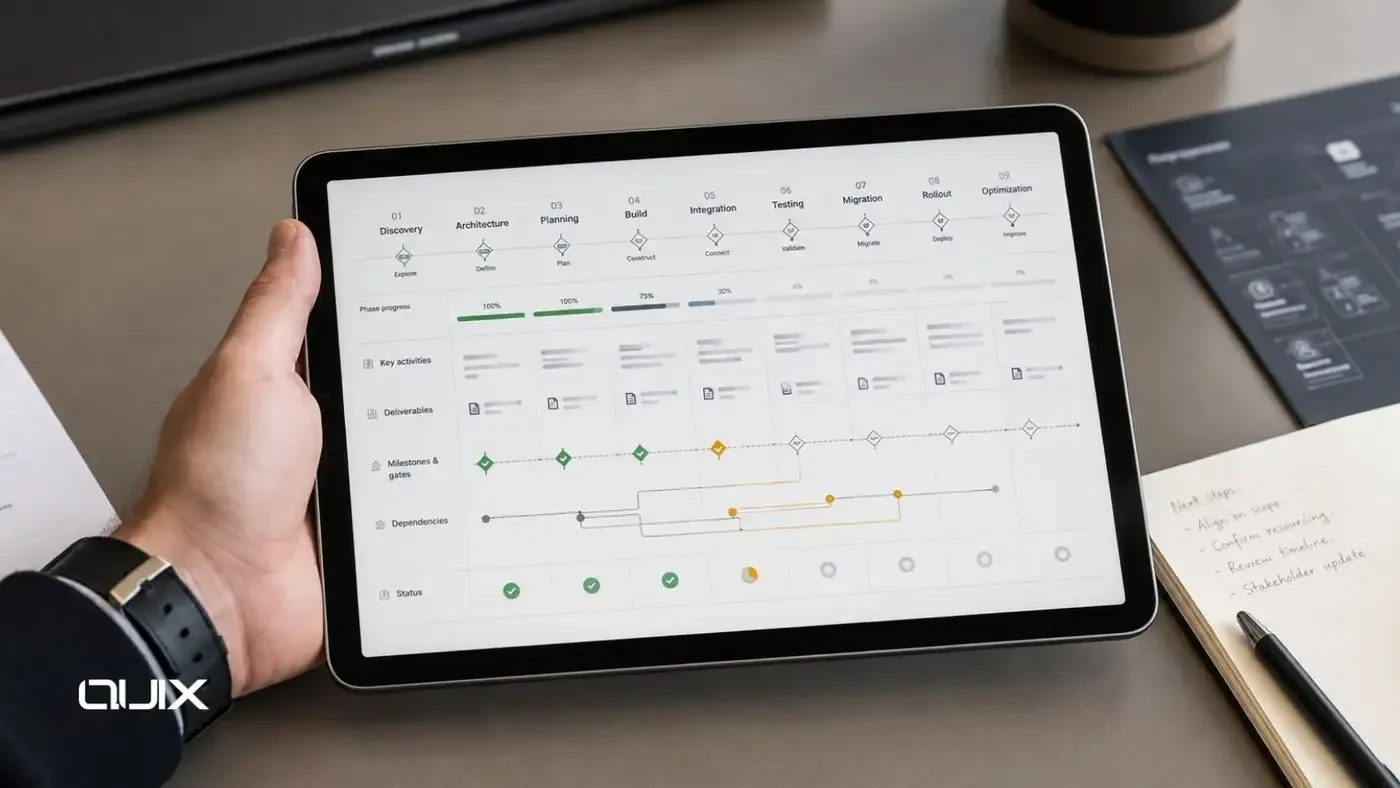
The lifecycle of enterprise implementation spans strategy validation, discovery and requirements, architecture confirmation, implementation planning, build and configuration, integration, quality assurance, data migration, rollout, change management, adoption, and post-launch optimization. Each phase produces specific outputs that the next phase depends on.
Implementation that skips or compresses phases consistently produces systems that require rework, generate user resistance, and fail to deliver the operational outcomes the business case projected.
The Enterprise Solution Implementation Lifecycle
Phase 1: Strategy Validation
Before any discovery or design work begins, the implementation strategy must be validated against the business objectives it is meant to serve. Which operational problem is the implementation solving? What does success look like in measurable terms? What is the risk tolerance? What is the timeline, and is it realistic given the scope?
Strategy validation prevents the most expensive class of implementation failure: completing a technically successful implementation of a solution that does not address the original business problem because the problem was never precisely defined.
Phase 2: Discovery and Requirements
Discovery is where operational reality meets implementation planning. Stakeholder interviews, workflow mapping, current system analysis, data review, and integration dependency identification produce the requirements that guide every subsequent implementation decision.
Requirements that emerge from discovery are significantly more complete and accurate than requirements defined by leadership assumption or vendor template. They reflect the edge cases, integration dependencies, data quality issues, and user experience expectations that determine whether the implementation will actually work for the people who use it daily.
Phase 3: Architecture Validation
Architecture validation confirms that the proposed solution design — platform configuration, integration architecture, data model, security and access control design — is technically sound and aligned with the requirements established in discovery.
This phase is particularly important when the implementation involves multiple systems, significant data migration, or complex integration requirements. Architecture decisions made here propagate through every subsequent phase. Catching architecture problems before build begins is significantly less expensive than catching them during testing or after go-live.
Phase 4: Implementation Planning
Implementation planning produces the project plan that guides the build phase: work breakdown, timeline, resource assignments, dependency sequencing, risk controls, decision gates, and governance procedures.
A strong implementation plan treats risk explicitly. Which work items have the most uncertainty? Where are the external dependencies that could introduce delays? Which integration or migration tasks are on the critical path? What is the contingency for each risk?
Phase 5: Build and Configuration
Build and configuration is where the platform is configured, custom code is developed, workflows are defined, permission structures are established, and reporting is designed. This phase proceeds against the requirements and architecture established earlier — not against real-time decisions made during the build.
Scope creep is the primary risk during build. Requirements that were not defined during discovery surface during configuration when stakeholders see the system taking shape and realize what was not included. A well-run implementation has a defined process for evaluating scope change requests: impact on timeline, cost, and other in-flight work items must be assessed before any scope change is accepted.
Phase 6: Integration
Integration work connects the new solution to the other systems in the enterprise landscape. This work must be sequenced carefully: integration depends on the target system being stable enough to integrate against, and the integrations must be validated before the broader system is considered ready for testing.
Integration is frequently the phase where implementation projects experience the most unexpected complexity. Requirements that seemed clear in discovery reveal additional technical constraints when implementation begins. Scheduling adequate time for integration development and testing is one of the most reliable indicators of whether an implementation will complete on time.
Phase 7: Quality Assurance and Testing
QA covers functional testing (does the system do what it was designed to do?), integration testing (do connected systems exchange data correctly?), performance testing (does the system perform acceptably under realistic load?), security testing (are access controls, encryption, and audit requirements met?), and user acceptance testing (do the actual users find the system usable for their real work?).
User acceptance testing is the phase most commonly compressed or skipped in enterprise implementations that are running behind schedule. This is exactly backwards. UAT is the last opportunity to catch usability, workflow, and requirements issues before they become post-launch support problems.
Phase 8: Data Migration
Data migration moves existing data from legacy systems into the new solution. This is technically complex, risk-intensive, and often underestimated. Legacy data frequently does not conform to the new system's data model, contains quality issues, or includes records with ambiguous ownership or status.
A rigorous data migration program includes data profiling, migration rule development, test migration runs with validation, cut-over migration planning, and a rollback plan if the migration produces unexpected results.
Phase 9: Rollout and Change Management
Rollout is not a single event. It is a managed transition from the old way of working to the new one, designed to minimize disruption and maximize adoption. Change management — communicating what is changing, training users on new workflows, supporting them during the transition, and measuring adoption — is the work that determines whether users embrace the new system or route around it.
Systems that are technically excellent and poorly adopted consistently underperform against the business case. The technology investment is only realized when users operate through the system as designed.
Phase 10: Post-Launch Optimization
The first ninety days after go-live reveal operational patterns that no discovery or testing phase can fully anticipate. Real users interact with the system in ways that do not match documented workflows. Integration edge cases that did not appear in testing surface under real operational load. Performance characteristics change when actual transaction volumes replace test scenarios.
Post-launch optimization is the structured process of monitoring, identifying, and addressing these gaps. It is the phase that converts a system that is live into a system that is working as intended.
Implementation Readiness Checklist
Before committing to implementation, assess readiness across these dimensions.
- Is there a clear, measurable definition of what implementation success looks like?
- Have business, operational, and technical requirements been formally defined through a discovery process?
- Has the solution architecture been validated against requirements before build begins?
- Is there an executive sponsor with authority to resolve scope and priority disputes?
- Has the integration architecture been designed and validated before the integration build begins?
- Is there a data migration plan that includes profiling, test migration, and rollback capability?
- Is user acceptance testing planned with real users before go-live?
- Is there a change management and training plan for every team that will use the new system?
- Is there a post-launch optimization plan with defined success metrics and a review timeline?
- Has realistic contingency time been included in the implementation timeline for integration and migration complexity?
FAQ
What is enterprise solution implementation?
Enterprise solution implementation is the end-to-end process of translating a business requirement into a working system that operates reliably in production, integrates with connected systems, is governed appropriately, and is adopted by the teams it serves — covering discovery, architecture, build, integration, QA, migration, rollout, and optimization.
Why do enterprise implementations often underperform against their business case?
They frequently underinvest in the non-technical work: discovery, requirements definition, change management, user training, and post-launch optimization. Systems configured around assumptions rather than validated requirements, and poorly adopted by the teams they serve, cannot deliver the operational outcomes the business case projected.
Why is data migration consistently underestimated in enterprise implementations?
Legacy data rarely conforms cleanly to a new system's data model. It contains quality issues, inconsistent formats, ambiguous record status, and complex ownership rules that only reveal themselves during profiling and test migration runs. Adequate time for profiling, transformation rule development, test migration, and validation is essential.
What is user acceptance testing and why does it matter?
User acceptance testing has actual users validate that the system is usable for their real work. It is the last opportunity to catch usability, workflow, and requirements issues before go-live. It is also the phase most commonly compressed in behind-schedule projects — which converts pre-launch issues into post-launch support problems.
What should post-launch optimization address?
Post-launch optimization addresses the operational patterns, integration edge cases, and performance characteristics that only emerge when real users work through the system under actual operational load. It is the phase that converts a live system into one that is working as the business case intended.