Enterprise solutions fail during implementation at rates that should be embarrassing to the industry. The technology is rarely the primary cause.
The causes are organizational, architectural, and process-related: unclear requirements that lead to a system configured around assumptions, weak executive alignment that fails to resolve competing priorities, integration complexity that was underestimated during planning, data migration issues that surface too late to address without delaying go-live, scope creep that expands the project without expanding the timeline, and user adoption failure that turns a technically functional system into an operational underperformer.
These failures are not inevitable. They are the predictable results of specific organizational and architectural decisions made during planning. Understanding them before an implementation begins is the most effective risk management investment an enterprise can make.
Executive Summary
Enterprise implementation failures cluster around a consistent set of root causes. The technology is rarely the primary failure point. The failures that most commonly determine implementation outcomes are: unclear or disputed requirements, absent executive alignment, underplanned integration architecture, unmanaged data migration complexity, scope creep without governance, inadequate quality assurance, poor change management, and absent post-launch optimization.
Each of these failure modes is preventable with the right process, governance, and expertise applied at the right stage of the implementation. This article explains each failure mode, why it occurs, and what specifically prevents it.
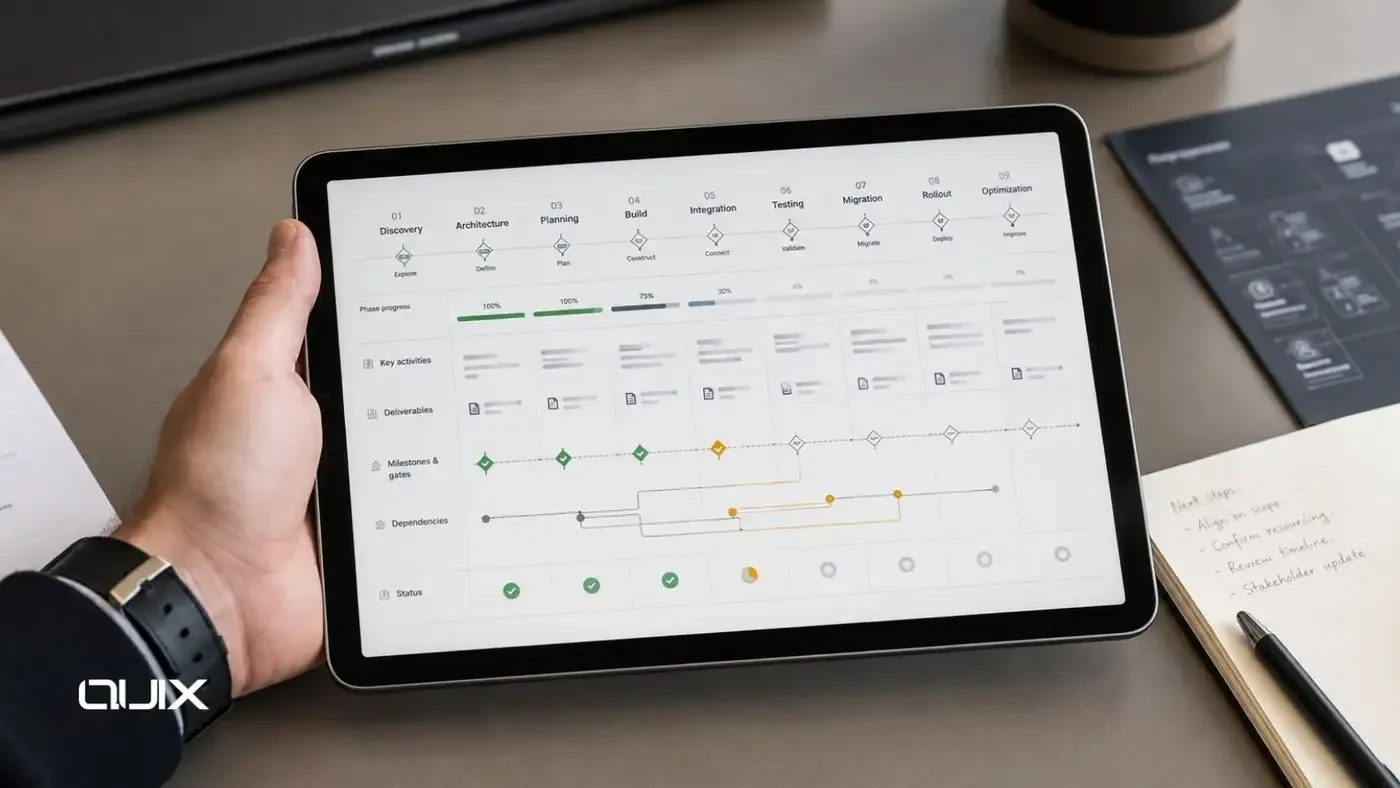
The Implementation Failure Risk Map
Implementation failures rarely arrive as a single catastrophic event. They accumulate through a series of decisions and omissions that individually appear manageable but collectively determine whether the implementation succeeds.
Failure Mode 1: Unclear Requirements
Requirements that are vague, assumed, or contested are the most common root cause of enterprise implementation failure. When the requirements are not precisely defined, the implementation team makes configuration decisions based on their interpretation of what the business needs. These interpretations are frequently wrong in ways that only become visible during user acceptance testing or after go-live.
The cause is almost always a discovery process that was too short, too narrow, or too dependent on leadership input without operational validation. Leaders describe how they believe the business works. Operational teams know how it actually works. Requirements derived from leadership belief without operational validation consistently miss the edge cases, informal processes, and system dependencies that shape whether an implementation works in practice.
Prevention: Conduct discovery with all stakeholder groups. Validate requirements with the operational teams who will use the system daily. Document requirements with enough specificity to build against without requiring ongoing stakeholder clarification.
Failure Mode 2: Weak Executive Alignment
Enterprise implementations span multiple functions, require trade-off decisions that affect different departments differently, and encounter scope and priority disputes that cannot be resolved at the project level. When executive alignment is weak — when the executive sponsor does not have authority over all affected functions, or when executive support diminishes as the project becomes complex — these disputes go unresolved and the project stalls.
Weak alignment also produces the symptom of competing requirements from different functions that are never reconciled. Sales, finance, and operations each request conflicting configurations because no one with cross-functional authority has defined what the implementation will prioritize.
Prevention: Identify an executive sponsor with genuine authority over all affected functions before the project begins. Establish a governance model that defines who has authority to resolve scope and priority disputes. Maintain executive visibility into project status throughout, not just at escalation points.
Failure Mode 3: Underplanned Integration
Integration is consistently the most underestimated component of enterprise implementation. The gap between "we need to connect these two systems" and "here is the fully specified, tested, production-ready integration" is almost always larger than the implementation plan allows for.
Integration complexity surprises emerge from API documentation that does not match API behavior, data formats in the source system that differ from what the target system expects, authentication and security requirements that were not included in the initial scope, and performance characteristics that are only discovered when realistic transaction volumes are tested.
Prevention: Conduct a technical integration assessment during architecture phase, before build begins. Schedule integration build time based on the assessed complexity, not the expected complexity. Build integration test environments before integration development begins, not during it.
Failure Mode 4: Data Migration Underestimation
Data migration is where the accumulated data quality debt of the legacy system becomes an implementation problem. Legacy data that contains duplicate records, inconsistent formats, missing required fields, outdated statuses, and business rule violations in the new system's data model cannot be migrated without transformation — and transformation rules for complex legacy data are time-consuming to develop and validate.
Organizations that have not conducted a data profiling exercise before planning their migration timeline consistently discover scope that was not accounted for, usually during or after the cut-over migration when there is no time to address it properly.
Prevention: Profile the source data before estimating migration timeline. Develop and test transformation rules before the migration timeline is finalized. Plan for at least two test migration cycles before cut-over, with validation reporting after each.
Failure Mode 5: Scope Creep Without Governance
Scope creep is the gradual expansion of implementation scope without equivalent expansion of timeline or budget. It occurs when stakeholders see the system taking shape and identify requirements that were not captured in discovery, when new business needs emerge during a long implementation, or when the implementation team accepts informal scope additions that are not formally reviewed.
The damage of scope creep is not just budget overrun. It is the compression of timeline for QA, testing, training, and change management that occurs when scope expansion is absorbed without timeline adjustment. The phases that are most commonly compressed are exactly the phases that determine whether the implementation achieves adoption.
Prevention: Define scope formally at the start and establish a change control process that requires impact assessment before any scope addition is accepted. This is not rigidity — it is the governance that makes rational scope decisions possible rather than allowing scope to grow invisibly.
Failure Mode 6: Inadequate Change Management
Change management failure is the most common cause of technically successful implementations that underperform operationally. Users who were not included in discovery, not trained adequately before go-live, not supported effectively during transition, and not convinced of the system's value will find ways to work around it — shadow spreadsheets, workarounds in older systems, or simply not using the features that were designed to improve their work.
Prevention: Include representative users from all affected functions in discovery and UAT. Design training that covers real workflows, not just feature demonstrations. Plan for a dedicated support period after go-live. Measure adoption actively and address resistance before it becomes permanent.
Implementation Failure Prevention Checklist
- Has discovery been conducted with all operational stakeholder groups, not just leadership?
- Are requirements documented with sufficient specificity to build against without ongoing clarification?
- Is there a defined executive sponsor with authority to resolve cross-functional scope disputes?
- Has a technical integration assessment been completed before the integration build timeline was estimated?
- Has source data been profiled before the migration timeline was finalized?
- Is there a formal scope change process that requires impact assessment before acceptance?
- Is there a change management plan that addresses training, communication, and adoption for each user group?
- Is there a post-launch optimization plan that will address the gaps revealed by real operational use?
- Are there defined go/no-go criteria for each implementation phase gate?
- Is there a documented rollback plan that has been reviewed and approved before go-live?
FAQ
What are the most common causes of enterprise implementation failure?
The most common causes are unclear or disputed requirements, weak executive alignment, underplanned integration architecture, data migration complexity that was underestimated, scope creep without governance, inadequate quality assurance, poor change management, and absent post-launch optimization. Technology failure is rarely the primary cause.
Why is change management a critical implementation success factor?
Systems that are technically functional but poorly adopted cannot deliver the operational outcomes the business case projected. Users who were not involved in discovery, not trained adequately, or not supported during transition will work around the system rather than through it — negating the operational benefits the implementation was designed to deliver.
Why is integration consistently underestimated in implementation planning?
The gap between expected and actual integration complexity comes from API documentation that does not match API behavior, data format mismatches discovered during development, and performance characteristics that only appear under realistic load. These are difficult to anticipate without a technical integration assessment conducted before the integration build timeline is set.
What is scope creep and how does it damage implementations?
Scope creep is the gradual expansion of implementation scope without equivalent timeline or budget expansion. Its primary damage is the compression of QA, testing, training, and change management phases that occurs when scope growth is absorbed without timeline adjustment — exactly the phases most critical to implementation adoption and quality.
How should executive alignment be established for an enterprise implementation?
Identify an executive sponsor before the project begins who has genuine authority over all affected functions. Establish a governance model that defines who resolves scope and priority disputes. Maintain executive visibility throughout the project, not only at escalation points.