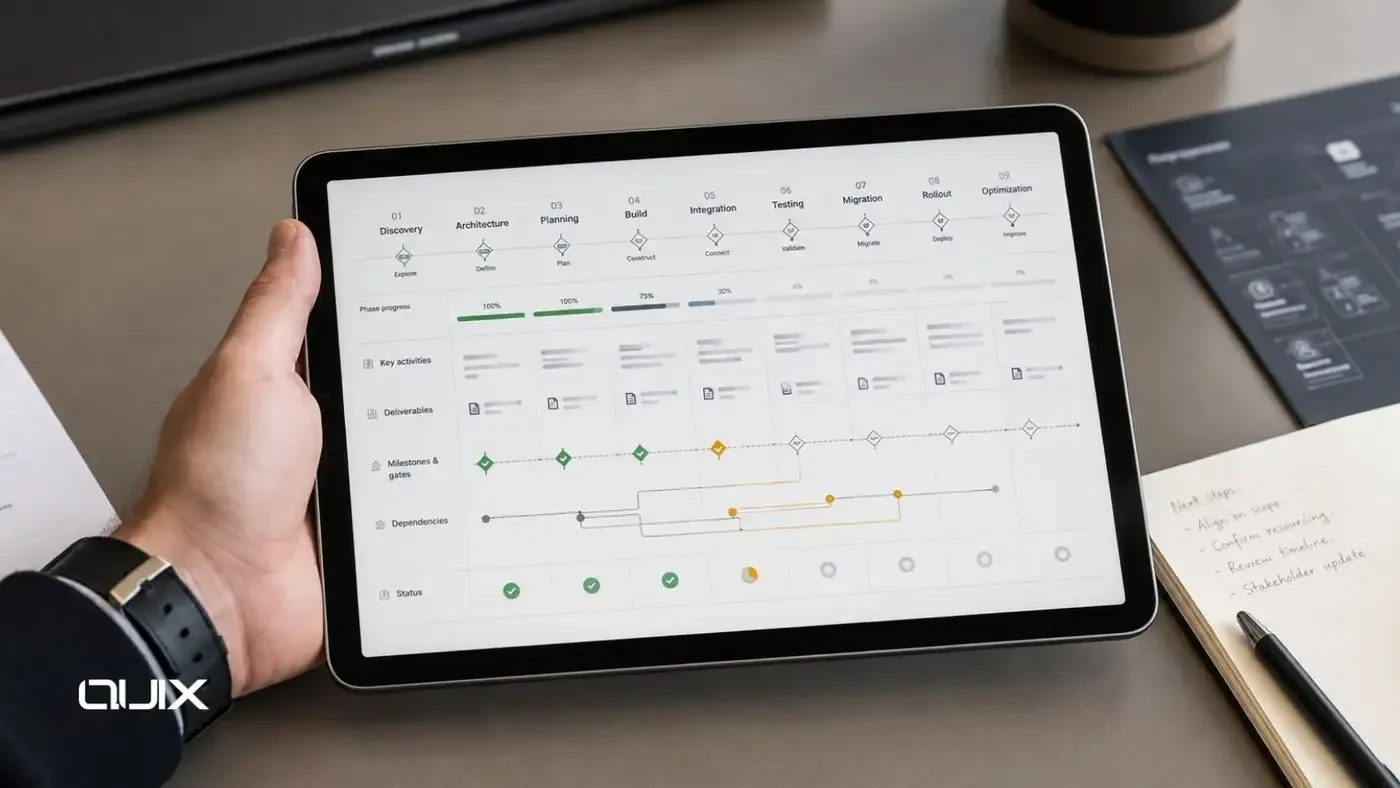
Quality assurance in enterprise implementation is not a phase that happens before go-live. It is a discipline that runs through every phase of the project — from requirements validation through architecture review, build verification, integration testing, performance testing, security assessment, and user acceptance, to post-launch monitoring.
Treating QA as a single pre-release gate consistently produces the same outcome: issues that could have been caught early surface late, when the cost and disruption of addressing them is highest. The defect found in production costs ten to twenty times more to fix than the same defect found during build. The integration failure discovered at go-live creates a production incident rather than a development task.
Executive Summary
Enterprise QA encompasses all testing and validation activities across the implementation lifecycle — from requirements review through post-launch monitoring. A mature QA program covers functional testing, integration testing, performance testing, security testing, data validation, user acceptance testing, and regression testing, each addressing a distinct dimension of implementation quality.
The goal of enterprise QA is not to eliminate all risk before go-live. It is to provide the organization with an accurate and complete picture of implementation quality, so that go/no-go decisions are made on evidence rather than optimism, and so that the risks that remain at go-live are known, documented, and managed.
The Enterprise QA Framework
A complete enterprise QA program covers seven testing disciplines, each with a distinct scope, method, and quality gate.
1. Requirements Validation
Requirements validation is the QA activity that catches the highest-leverage defects at the lowest cost. Before any build work begins, a structured review of the requirements document identifies gaps, ambiguities, contradictions, and missing edge cases that would produce incorrect implementation decisions if not resolved.
Requirements that fail validation have cost the equivalent of no build work yet. Requirements that fail validation after build is complete have cost the full build effort applied to the wrong specification.
2. Functional Testing
Functional testing validates that the configured system performs the operations specified in the requirements: workflows execute correctly, permission controls operate as designed, data is created and modified correctly, business rules are enforced, and exception handling produces the right outcomes.
Test cases for functional testing should be derived directly from the requirements document — not from the implementation team's understanding of what was built, which may differ from what was specified. Each requirement should have at least one corresponding test case.
3. Integration Testing
Integration testing validates that data flows correctly between connected systems: the right data moves in the right direction, at the right frequency, with the correct transformation applied, and with appropriate error handling when the flow encounters a failure condition.
Integration testing must be conducted in a test environment that approximates the production integration topology — not against mocked stubs that do not represent the behavior of the real systems the integration will interact with in production.
4. Performance Testing
Performance testing validates that the system meets its non-functional performance requirements under realistic load. For enterprise systems, this means testing at peak concurrent user counts, peak transaction volumes, and — critically — during the report generation and data processing cycles that create the highest system load.
Performance testing should include load tests (normal expected load), stress tests (load beyond expected peaks), and soak tests (sustained load over extended periods, which surface memory leaks and resource exhaustion that short-duration tests do not reveal).
5. Security Testing
Security testing validates that access controls prevent unauthorized data access, that authentication is correctly implemented, that sensitive data is encrypted in transit and at rest, that audit trails are capturing the events they are required to capture, and that the system does not expose security vulnerabilities that could be exploited after deployment.
For enterprise systems that handle customer, financial, or employee data, security testing should include penetration testing by an independent assessor — not just security configuration review by the implementation team.
6. Data Validation
Data validation testing verifies that migrated data is complete, correctly transformed, and consistent with the validation rules the new system enforces. It should be run on every test migration and on the production cut-over migration before the system goes live.
Data validation must check not just that records exist but that the values in critical fields are correct, that referential integrity between related records is maintained, and that records that failed migration validation have been captured and documented with a remediation plan.
7. User Acceptance Testing
UAT is conducted by actual users from each affected function, working through their real workflows in a test environment loaded with representative data. It validates that the system is usable for the actual work the organization does — not just technically functional according to specifications.
UAT findings fall into three categories: defects (the system does not do what was specified), specification gaps (the specification did not capture something the user needs), and change requests (the user wants something different from what was specified). Each category requires a different response, and the distinction must be made clearly during triage.
Test Environment Governance
The quality of testing is directly limited by the quality of the test environment. A test environment that does not represent production conditions will not surface the issues that production conditions create.
Enterprise implementations should maintain separate environments for each stage of testing: a development environment for unit testing during build, a QA environment for functional and integration testing, a performance testing environment that approximates production infrastructure, a staging environment that mirrors production as closely as possible for final pre-release validation, and a production environment.
Test data in the QA environment should include records that cover normal cases, edge cases, and the specific exception scenarios that the system must handle correctly. Test data that covers only normal cases produces tests that pass when normal cases are presented and fail when edge cases appear in production.
Bug Triage and Release Readiness
Not all defects have equal priority. Bug triage is the process of categorizing defects by severity and determining which must be resolved before go-live and which can be documented as known issues with a post-launch remediation plan.
A simple triage model categorizes defects into four levels: Critical (the system cannot perform a core operational function — must be resolved before go-live), High (significant functionality is impaired or data integrity is at risk — should be resolved before go-live), Medium (a workflow is impaired but has a documented workaround — may be deferred with stakeholder acceptance), Low (cosmetic or minor usability issues — deferred to post-launch backlog).
Release readiness sign-off should require: zero open critical defects, a documented list of high defects with remediation timeline and stakeholder acceptance, a documented list of medium and low defects with the post-launch backlog plan, and UAT sign-off from designated representatives of each affected user group.
QA Readiness Checklist
- Is there a QA test plan that covers all seven testing disciplines before build begins?
- Are test cases derived from the requirements document, with traceability from requirement to test case?
- Is there a QA environment that represents production conditions, loaded with representative test data?
- Is integration testing conducted against real system interfaces, not mocked stubs?
- Has performance testing been planned at 150% of peak expected production volume?
- Is there an independent security assessment planned before go-live for systems handling sensitive data?
- Is data validation testing planned for every test migration run and the production cut-over migration?
- Are UAT participants identified and prepared from every affected user group?
- Is there a bug triage process with defined severity levels and release readiness criteria?
- Is there a post-launch monitoring plan that will surface production issues not caught in pre-launch testing?
FAQ
What is the difference between QA and testing in enterprise implementation?
Testing is the execution of specific test cases against the system. QA is the broader discipline of ensuring quality across the entire implementation lifecycle — from requirements validation through post-launch monitoring. Testing is one component of QA, not a synonym for it.
Why must integration testing use real system interfaces?
Mocked interfaces simulate expected behavior, not actual behavior. Real production systems have undocumented edge cases, rate limiting behaviors, authentication quirks, and error response formats that mocks do not replicate. Integration testing against mocks passes tests that fail in production.
What should UAT reveal that functional testing does not?
Functional testing validates that the system does what the specification says. UAT validates that what the specification says matches what users actually need for their real work. UAT reveals usability gaps, missing edge case handling, and workflow design issues that were not captured in the specification.
What are the three categories of UAT findings?
Defects (the system does not do what was specified), specification gaps (the specification did not capture a legitimate requirement), and change requests (the user wants something different from what was specified). Each requires a different response: defects must be fixed, gaps must be assessed for scope impact, and change requests must go through scope change governance.
When is a system ready for production deployment?
When all critical defects are resolved, high defects are either resolved or formally accepted by stakeholders with documented workarounds, UAT sign-off has been received from representatives of each affected user group, performance testing has passed at production-scale volumes, and security testing has confirmed no open critical or high-severity findings.