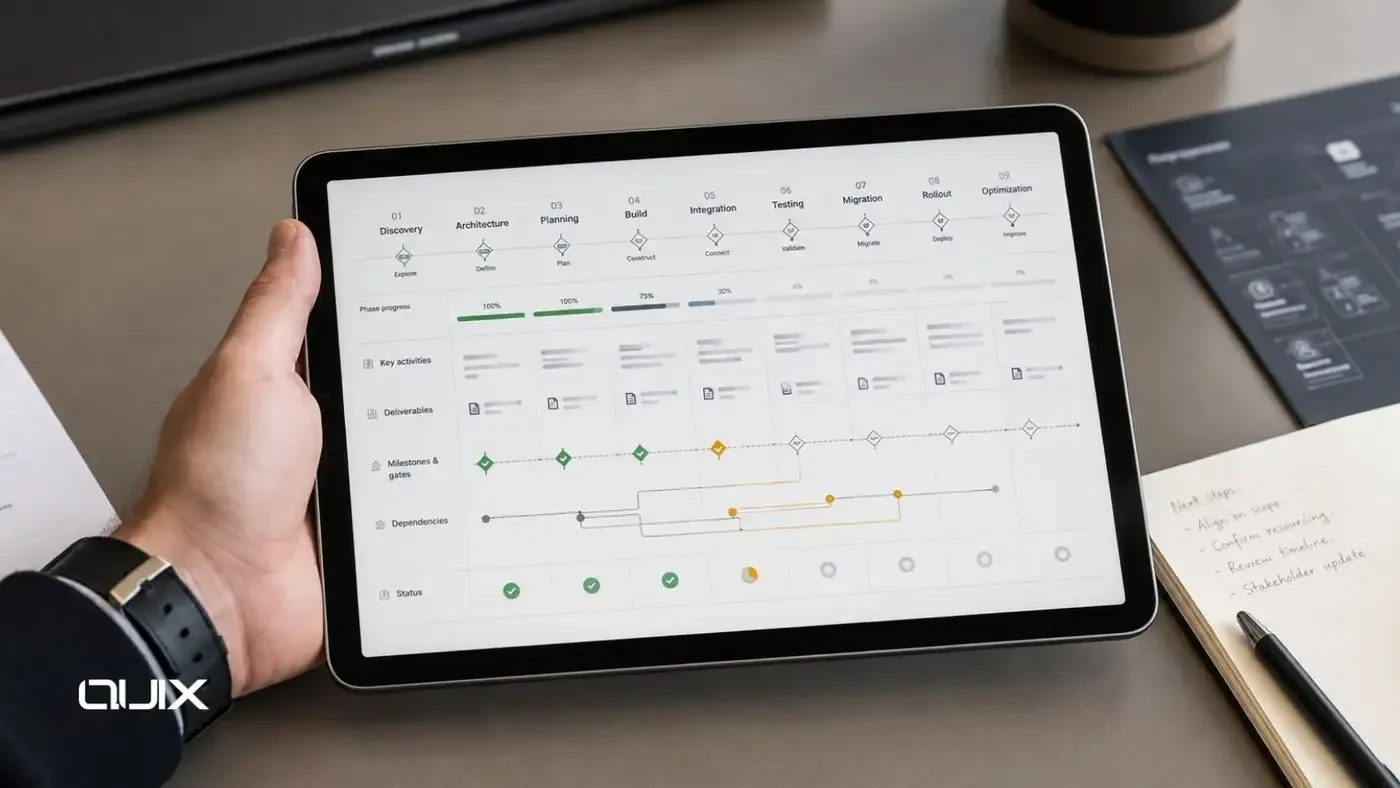
Implementation is not deployment. This distinction is the foundation of how Quix approaches enterprise solution delivery — and it is the reason our outcomes consistently differ from those of implementation programs that treat go-live as the primary objective.
Deployment means the system is live. Implementation means the organization is operating through it — with the processes, data quality, governance, integrations, and adoption that make the system a genuine operational improvement rather than an expensive addition to the technology landscape that people route around.
The Quix framework for enterprise solution implementation is structured around this principle. Every phase is designed not just to produce technical outputs but to build the operational foundation that makes adoption natural, that makes the system trustworthy, and that makes post-launch optimization a continuous capability rather than a reactive response to failures.
Executive Summary
The Quix Enterprise Solution Implementation Framework is a ten-phase methodology that covers the full implementation lifecycle: strategy validation, operational discovery, architecture confirmation, implementation planning, build and configuration, integration, quality assurance, data migration, rollout and change management, and post-launch optimization.
The framework is designed to address the failure modes that most commonly determine enterprise implementation outcomes: unclear requirements, weak executive alignment, underplanned integration, underestimated data migration, scope creep without governance, inadequate QA, poor change management, and absent post-launch optimization.
Each phase produces specific outputs. Each phase has a defined decision gate that must be passed before the next phase begins. This structure prevents the common failure pattern of advancing on a schedule rather than on quality evidence.
The Quix Implementation Principle: Operations First
Quix designs implementations around how the organization should operate, not around what the technology can do. This means the operating model is defined before the platform is configured, the processes are designed before the workflows are built, and the data ownership is established before the integrations are implemented.
This sequence prevents the most common implementation failure: a system that is technically correct and operationally wrong — configured around vendor defaults or implementation team assumptions rather than the specific operational requirements of the organization.
It also produces better adoption outcomes. Users who were involved in defining the workflows they will use adopt the system more readily than users who encounter a system that was designed without their input.
The Ten Phases of the Quix Enterprise Solution Implementation Framework
Phase 1: Strategy Validation
Every Quix engagement begins with strategy validation: confirming that the implementation objectives are specific and measurable, that the solution scope is aligned with the business problem, that the organizational readiness is adequate for the implementation to proceed, and that the timeline and resource plan are realistic.
Strategy validation is not a formality. It is the phase that prevents investing in the right solution for the wrong problem, or the right solution at the wrong organizational readiness level. The most expensive implementation failures are those that could have been prevented by two weeks of strategy validation at the start.
Phase 2: Operational Discovery
Discovery at Quix is broader than requirements gathering. It maps the operational reality of the organization: how workflows actually execute (not how they are documented), where data lives and how it is used, what manual processes are compensating for system gaps, what users find most frustrating about the current system, and what the implementation must do differently to produce a genuine improvement.
Discovery involves stakeholders at all levels: leadership for strategic requirements, operational managers for workflow and process requirements, front-line users for usability and daily task requirements, and technical stakeholders for integration, security, and infrastructure requirements.
Phase 3: Architecture Confirmation
Architecture confirmation validates that the proposed technical approach — platform configuration, data model, integration architecture, security and access design — is sound and will support the operational requirements defined in discovery.
This phase includes an independent architecture review: a structured assessment of the proposed design by someone who was not involved in producing it. Independent review catches design decisions that the architecture team has normalized to but that an objective assessment reveals as risks.
Phase 4: Implementation Planning
Quix implementation planning produces a roadmap that is sequenced by dependency and risk, not by what is easiest or fastest. Foundation work — data ownership, core integrations, process standards — comes first. Enhancement capabilities — automation, AI, advanced reporting — are sequenced after the foundation is stable.
The planning phase also produces the governance model for the implementation: scope change process, decision authority, escalation path, risk management approach, and vendor coordination framework for multi-party programs.
Phase 5: Build and Configuration
Build proceeds against the requirements and architecture established in the previous phases. Configuration decisions that are not covered by requirements are flagged for stakeholder resolution rather than made unilaterally by the implementation team.
During build, Quix maintains an open items register that captures every decision, open question, and deferred requirement. This prevents the silent accumulation of assumptions that become post-launch issues when the assumptions are wrong.
Phase 6: Integration
Integration is treated as a primary engineering workstream, not a secondary task completed after the main build. Each integration flow has a documented specification before development begins, is tested in isolation before end-to-end testing, and is validated against production-representative data before the integration layer is considered ready for QA.
Phase 7: Quality Assurance
Quix QA covers all seven testing disciplines: requirements validation, functional testing, integration testing, performance testing, security testing, data validation, and user acceptance testing. Each discipline has defined test cases, a defined environment, a defined execution plan, and defined quality gates that must be met before the testing phase is considered complete.
Bug triage is conducted continuously during QA — not as a single session before go-live. This allows critical and high-severity defects to be resolved and retested before the testing phase closes, rather than carrying open high-priority issues into release readiness review.
Phase 8: Data Migration
Quix data migration follows a structured strategy: source assessment, transformation rule development and stakeholder review, data cleansing with business-owned decisions, multiple test migration cycles with validation reporting, cutover planning with rehearsed timing, and a documented rollback plan with specific criteria that trigger rollback.
The source system remains accessible in read-only mode for sixty days after cut-over. This is a non-negotiable element of the Quix migration approach — the safety net it provides is worth the modest operational overhead of maintaining access.
Phase 9: Rollout and Change Management
Quix rollout planning considers three dimensions simultaneously: the technical transition (system go-live), the process transition (workflows changing from old to new), and the people transition (users adopting new behaviors). All three must be ready before go-live proceeds — a technically ready system with organizationally unprepared users produces poor adoption outcomes regardless of system quality.
Change management is embedded throughout the implementation, not added at the end. Users are involved in discovery. Champions are identified and prepared during build. Role-specific training is developed during QA and delivered before go-live. The feedback mechanism is active from day one of production.
Phase 10: Post-Launch Optimization
The Quix engagement does not close at go-live. The post-launch optimization phase runs for ninety days, with structured reviews at thirty, sixty, and ninety days. Each review assesses adoption metrics, performance against implementation objectives, outstanding issues, and the optimization backlog.
At the ninety-day review, Quix produces a continuous improvement roadmap: a prioritized backlog of workflow refinements, automation opportunities, reporting improvements, and future-phase capabilities that have been identified during the optimization period.
The Quix Framework at a Glance
|
Phase |
Primary Focus |
Decision Gate |
|---|---|---|
|
Objectives, scope, readiness, timeline |
Proceed only with confirmed business case and realistic plan |
|
Workflows, data, requirements, constraints |
Validated requirements before architecture |
|
Technical design, independence review |
Architecture validated before build |
|
Roadmap, governance, vendor coordination |
Realistic plan with governance before build |
|
Platform configuration, custom development |
Internal review before integration |
|
Integration development and unit testing |
All integrations tested before QA |
|
Seven testing disciplines with quality gates |
All disciplines complete before migration |
|
Test cycles, validation, cutover, rollback |
Migration validated before rollout |
|
Technical, process, and people transition |
All three dimensions ready before go-live |
|
30/60/90-day reviews, continuous improvement |
Success metrics met at 90-day review |
FAQ
What is the Quix enterprise solution implementation framework?
It is a ten-phase methodology covering strategy validation, operational discovery, architecture confirmation, implementation planning, build, integration, QA, data migration, rollout and change management, and post-launch optimization — designed to produce operational transformation rather than technical deployment.
How does Quix distinguish implementation from deployment?
Deployment means the system is live. Implementation means the organization is operating through it — with correct processes, trusted data, clean integrations, appropriate governance, and genuine user adoption. Quix designs every phase to produce operational outcomes, not just technical deliverables.
What is an independent architecture review?
A structured assessment of the proposed technical design by someone who was not involved in producing it. It catches design decisions that the architecture team has normalized to but that an objective assessment reveals as risks — before those risks are embedded in a build that is expensive to change.
Why does Quix keep the source system accessible after cutover?
The source system provides a reference for resolving data questions that arise during early production operation — questions that only emerge when real users interact with real data. Decommissioning immediately after cutover eliminates the ability to investigate and resolve migration discrepancies discovered in the first sixty days.
What does the Quix 90-day optimization review produce?
A continuous improvement roadmap: a prioritized backlog of workflow refinements, automation opportunities, reporting improvements, and future-phase capabilities identified during the post-launch optimization period, with business impact and implementation complexity assessments for each item.