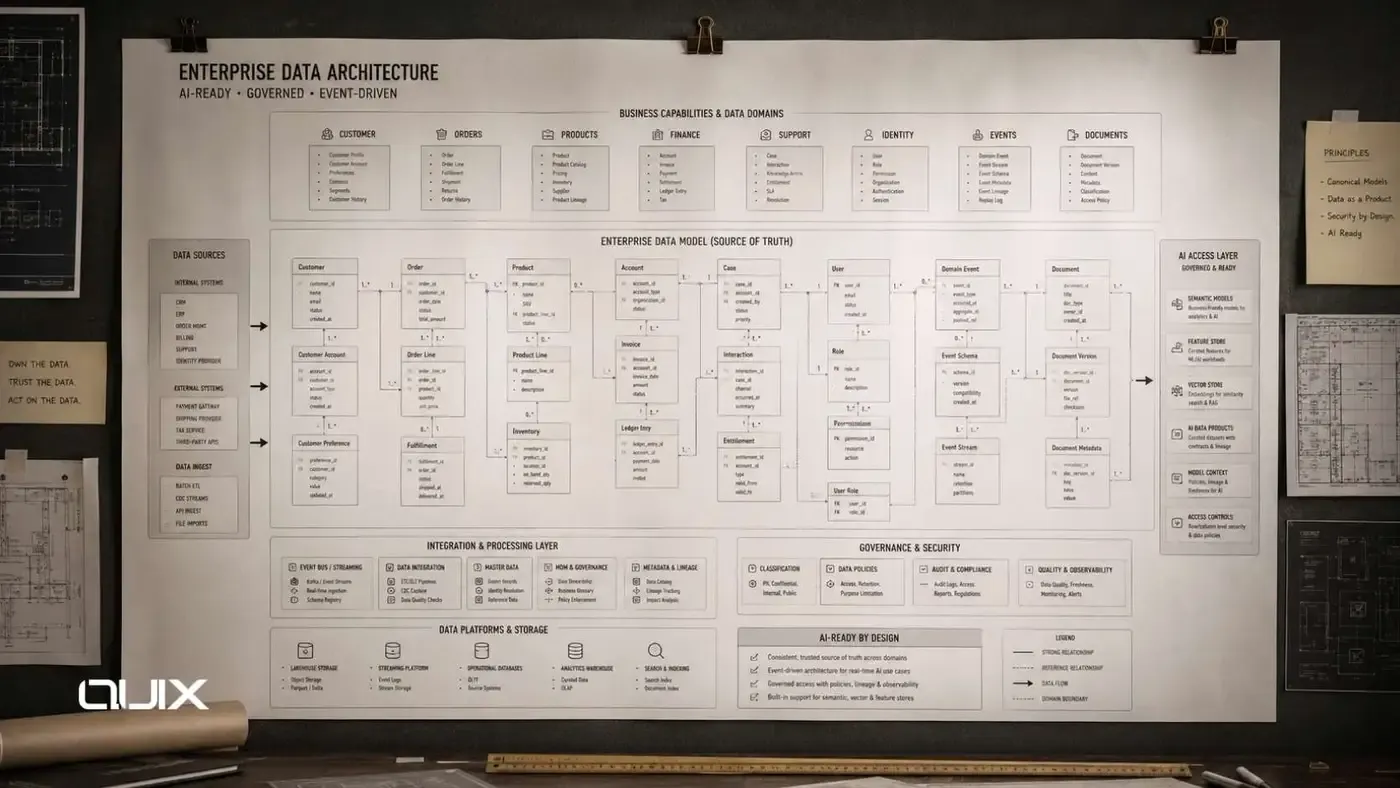
Every enterprise system design engagement starts with the same observation: the complexity the organization is experiencing is real, but it was not inevitable. It accumulated because the system was never designed — it was assembled.
Tools were added as problems appeared. Processes were documented after they were already broken. Integrations were built to solve immediate pain rather than to support long-term architecture. Data ownership was assumed rather than defined. AI was introduced before the system underneath it was structured to support it.
The Quix framework for enterprise system design was developed to address this directly. It is a structured methodology for designing enterprise operating systems that are intelligent from the start — built around the business, not the technology.
Executive Summary
The Quix Enterprise System Design Framework is an eight-phase methodology for designing scalable, intelligent, AI-ready enterprise systems. It moves from operational discovery through architecture design, process mapping, tool alignment, data flow design, integration planning, governance, and implementation roadmap.
The framework is built on a single foundational principle: systems before tools. This means the operating model is designed before platforms are selected, the data architecture is defined before integrations are built, and governance is embedded before AI is deployed.
This article explains each phase of the framework, why the sequence matters, and how the framework produces enterprise systems that scale reliably, integrate cleanly, and support AI as a genuine operational capability rather than an isolated experiment.
The Quix Principle: Systems Before Tools
Quix designs systems before we choose tools. This is not a preference. It is the core architecture principle behind every engagement we run.
The most common failure pattern in enterprise technology is the opposite sequence: a tool is selected, often based on market reputation, vendor relationship, or a compelling demonstration, and then the organization tries to design its operating model around the tool's capabilities and constraints.
When the operating model is designed around the tool, two things happen. First, the tool's default configuration becomes the operating logic of the business — which means the business is operationally defined by what the vendor thought a typical customer would need, not what the specific organization actually requires. Second, when the business outgrows the tool, or when the tool changes, or when a better tool becomes available, the operating model must be reconstructed rather than the tool simply replaced.
When the system is designed first, the tool serves the operating model. The system architecture defines what the tool must do, how it must integrate, what data it must manage, and how it must be governed. The tool then becomes an implementation choice rather than an architectural constraint.
The Eight Phases of the Quix Enterprise System Design Framework
Phase 1: Operational Discovery
Discovery is where most enterprise system design efforts fail. They either skip it entirely — jumping to architecture based on stakeholder assumptions — or they conduct it too narrowly, interviewing only leadership without observing actual operations.
Quix discovery combines leadership interviews, operational stakeholder sessions, workflow observation, system audit, data review, and gap analysis. The goal is to build an accurate picture of how the business actually works today versus how leadership believes it works. This gap is consistently the most important finding in the engagement — and the one that most directly shapes the architecture decisions that follow.
Discovery outputs include a current-state operating map, a systems and data inventory, a list of critical operational gaps, and a set of design constraints that must be respected in the target architecture.
Phase 2: Target Operating Model Design
The target operating model defines how the business should work at its next stage of scale. It covers the organizational structure, service delivery model, customer journey, internal workflows, decision rights, team responsibilities, and operational standards that the enterprise system must support.
This is a business design exercise, not a technology exercise. The technology architecture is derived from the operating model, not the other way around. A target operating model that reflects the business's genuine strategic and operational requirements produces a significantly different — and more effective — technology architecture than one that is defined by what the current toolset can support.
Phase 3: Process Architecture
Process architecture translates the target operating model into structured workflow designs. For each critical business process, Quix defines the trigger conditions, step sequence, ownership assignments, decision logic, data requirements, exception handling rules, and integration dependencies.
Process architecture is the bridge between business design and system design. Without it, system configuration inherits the informal behavior of the current state rather than implementing the structured behavior the organization needs.
Phase 4: Tool and Platform Alignment
Only after the operating model and process architecture are defined does Quix address tool selection. At this stage, the question is not "which tool is most popular?" but "which tool best supports this specific operating model, process architecture, and integration requirement?"
Tool alignment covers the evaluation of current platforms (should they be retained, reconfigured, or replaced?), the assessment of market options for specific functional requirements, and the decision logic for build vs buy vs integrate for each capability area.
Phase 5: Data Flow Design
Data flow design defines how information moves between systems, teams, and processes across the organization. This covers data ownership assignments, synchronization logic, integration patterns, data quality requirements, transformation rules, and the event triggers that initiate data movement.
This phase is particularly important for AI readiness. The data flows defined here are the supply chain for every analytics, reporting, automation, and AI use case the organization will pursue. Designing them correctly at this stage prevents the most expensive class of AI deployment failures.
Phase 6: Integration Architecture
Integration architecture defines how the platforms, data stores, and processes identified in the previous phases should connect. This includes the choice of integration patterns (API-led, event-driven, middleware, iPaaS, or hybrid), the definition of integration contracts, the design of error handling and failure recovery, and the observability requirements for the integration layer.
Quix designs integration architecture before implementation begins. This prevents the most common enterprise integration failure: a growing network of point-to-point connections that becomes unmaintainable as the application landscape evolves.
Phase 7: Governance, Security, and Compliance
Governance design defines the rules that protect the system's integrity as the organization grows and changes. This includes access control design, approval workflow architecture, data change governance, audit trail requirements, compliance controls, and the permission model for automation and AI components.
Governance is embedded in the system architecture rather than added after the fact. Systems that are designed with governance from the start are significantly easier to operate, audit, and evolve than those where governance is imposed as a compliance requirement after implementation.
Phase 8: Implementation Roadmap
The implementation roadmap translates the system architecture into a prioritized delivery plan. It defines which components should be implemented first, based on dependency relationships, business impact, implementation risk, and organizational readiness.
The roadmap distinguishes between foundational work (data ownership, core integrations, process standardization) that must be completed first, enabling work (platform configuration, automation, analytics) that depends on the foundation, and enhancement work (advanced AI capabilities, real-time intelligence, workflow optimization) that delivers value on top of a stable foundation.
A Quix roadmap always creates early, visible operational improvements while protecting the long-term architecture. This is important for sustaining organizational commitment to the program and for demonstrating return on investment while the foundational work continues.
The Quix Framework at a Glance
|
Phase |
Focus |
Output |
|---|---|---|
|
Understand how the business actually works today |
Current-state operating map and gap analysis |
|
Define how the business should work at scale |
Organizational design and workflow standards |
|
Map workflow logic, ownership, and data requirements |
Process architecture documentation |
|
Select platforms to support the defined operating model |
Platform evaluation and selection rationale |
|
Define data ownership, movement, and quality requirements |
Data flow architecture and ownership model |
|
Design how systems connect, communicate, and recover |
Integration blueprint and pattern selection |
|
Embed access controls, approval logic, and compliance |
Governance and permission architecture |
|
Sequence delivery by dependency, impact, and risk |
Phased implementation plan with priorities |
Why the Sequence Matters
The eight phases are designed in a specific sequence because each phase depends on the outputs of the previous ones.
Tool selection before operating model design produces systems configured around vendor defaults. Integration design before data flow design produces connections that do not carry the right data. Governance design before process architecture produces controls that do not match the workflows they are meant to protect. Implementation before any of the above produces a system that must be redesigned at significant cost after go-live.
This is the core reason why enterprise system design projects that skip phases or reverse the sequence consistently produce suboptimal results. The sequence is not arbitrary. It reflects the actual dependency structure of the design decisions being made.
Quix enforces this sequence not as a bureaucratic requirement but as a quality guarantee. Each phase builds on a foundation that the previous phase established. Skipping phases means implementing on an incomplete foundation — which creates the exact kind of structural debt the framework was designed to prevent.
Where the Quix Framework Differs from Traditional Approaches
Traditional enterprise technology projects typically start with a business case, move to vendor selection, and then define requirements during implementation. Architecture is often produced to document decisions that have already been made rather than to inform decisions that are being made.
The Quix framework reverses this. Architecture defines the requirements. Requirements drive platform selection. Platform selection determines implementation scope. This sequence ensures that the system serves the business rather than the business adapting to the system.
A second difference is the explicit integration of AI readiness throughout the framework. Every phase includes AI readiness considerations: data structures that support model consumption, workflows that can accommodate intelligent automation, integration patterns that allow AI systems to access operational context, governance models that extend to AI identities, and observability infrastructure that supports model monitoring.
This integration of AI readiness into the core framework means that organizations engaging Quix are not just building a system for today's operations. They are building a foundation for intelligent operations as their AI ambitions mature.
What the Quix Framework Produces
The output of a Quix enterprise system design engagement is not primarily documentation. It is a working architecture decision base that guides every subsequent implementation decision.
Leadership receives a clear view of how the business should operate digitally, which systems are essential, and how transformation should be sequenced.
Technology teams receive an architecture blueprint, integration design, data ownership model, governance framework, and implementation roadmap that guides platform configuration, custom development, and automation work.
Operations teams receive a process architecture that defines standardized workflows, ownership assignments, and exception handling procedures that can be implemented in the platforms selected.
The organization as a whole gains a shared understanding of the target system — which is itself one of the most valuable outputs of the engagement, because it replaces the fragmented, often contradictory views of the target state that typically exist in complex organizations.
FAQ
What is the Quix enterprise system design framework?
It is an eight-phase methodology for designing intelligent, scalable enterprise operating systems, covering operational discovery, target operating model design, process architecture, tool alignment, data flow design, integration architecture, governance, and implementation roadmap.
Why does Quix design systems before choosing tools?
When tools are selected before the system is designed, the tool's default configuration becomes the operating logic. This creates operational constraints that serve the vendor's template rather than the organization's specific requirements. System-first design ensures tools serve the operating model.
How long does a Quix enterprise system design engagement take?
Engagement duration varies by organizational complexity. Discovery and architecture phases typically run four to eight weeks. Full framework delivery including implementation roadmap typically completes in eight to sixteen weeks, depending on the scope of systems and processes involved.
What does the Quix framework produce?
The framework produces a current-state operating map, target operating model, process architecture, platform evaluation and selection rationale, data flow architecture, integration blueprint, governance and permission model, and a phased implementation roadmap.
How does the Quix framework address AI readiness?
AI readiness is embedded throughout every phase of the framework. Data structures, workflow designs, integration patterns, governance models, and observability requirements are all designed with AI system requirements in mind from the start of the engagement.