Enterprise implementations rarely involve a single vendor. A typical complex implementation involves the platform vendor, the implementation partner, the integration specialist, the internal IT team, the business project team, and sometimes additional specialized vendors for security, data migration, or change management.
Each party has its own scope, its own timeline, its own delivery standards, and its own understanding of who is responsible for what when something is in the gap between documented scopes. When those gaps are not explicitly closed by a coordination framework, they become the source of delivery risk, schedule delays, and escalation cycles that consume leadership time and damage implementation confidence.
Executive Summary
Vendor coordination in complex enterprise implementations is the governance discipline that defines how multiple parties — platform vendors, implementation partners, internal teams, integration specialists, and other vendors — operate together within a single implementation program.
Effective vendor coordination does not happen through goodwill and shared calendars. It requires explicit responsibility mapping, defined interface points between parties, a shared project timeline that reflects cross-party dependencies, an escalation structure that resolves cross-vendor conflicts at the right authority level, and a communication model that keeps all parties aligned without creating coordination overhead that exceeds its value.
The Most Common Multi-Vendor Failure Patterns
Gap Disputes
Gap disputes occur when a deliverable falls between the documented scope of two vendors. Vendor A says it is in scope for Vendor B. Vendor B says it is in scope for Vendor A. The client organization is left to resolve the dispute — which requires escalation, negotiation, and often additional contract negotiation — while the delivery schedule waits.
Gap disputes are preventable through explicit interface documentation: for each deliverable that crosses a scope boundary, define which party produces it, which party receives it, what quality criteria it must meet, and what happens when it does not meet those criteria.
Dependency Compression
In multi-vendor implementations, Party B cannot start its work until Party A delivers a dependency. When Party A is delayed, Party B's timeline compresses. If the compressed timeline is not acknowledged and renegotiated, Party B attempts to deliver in less time than the work requires, producing lower quality outputs that create problems downstream.
Dependency compression is prevented by maintaining a cross-party dependency map that is updated when any party reports a delay, and by negotiating timeline adjustments across all affected parties when a dependency shifts.
Communication Proliferation
Multi-vendor programs tend to generate excessive communication as each party attempts to keep all other parties informed. Status updates, issue logs, risk registers, and decision logs proliferate across multiple channels. Key information gets buried in volume. Critical decisions are made in bilateral conversations that are not visible to other parties who are affected by them.
Communication governance defines the canonical information sources, the update frequency, the meeting structure, and the decision-making authority that prevent communication from becoming the implementation's primary bottleneck.
The Vendor Coordination Framework
Effective vendor coordination operates across four dimensions.
Dimension 1: Responsibility Mapping
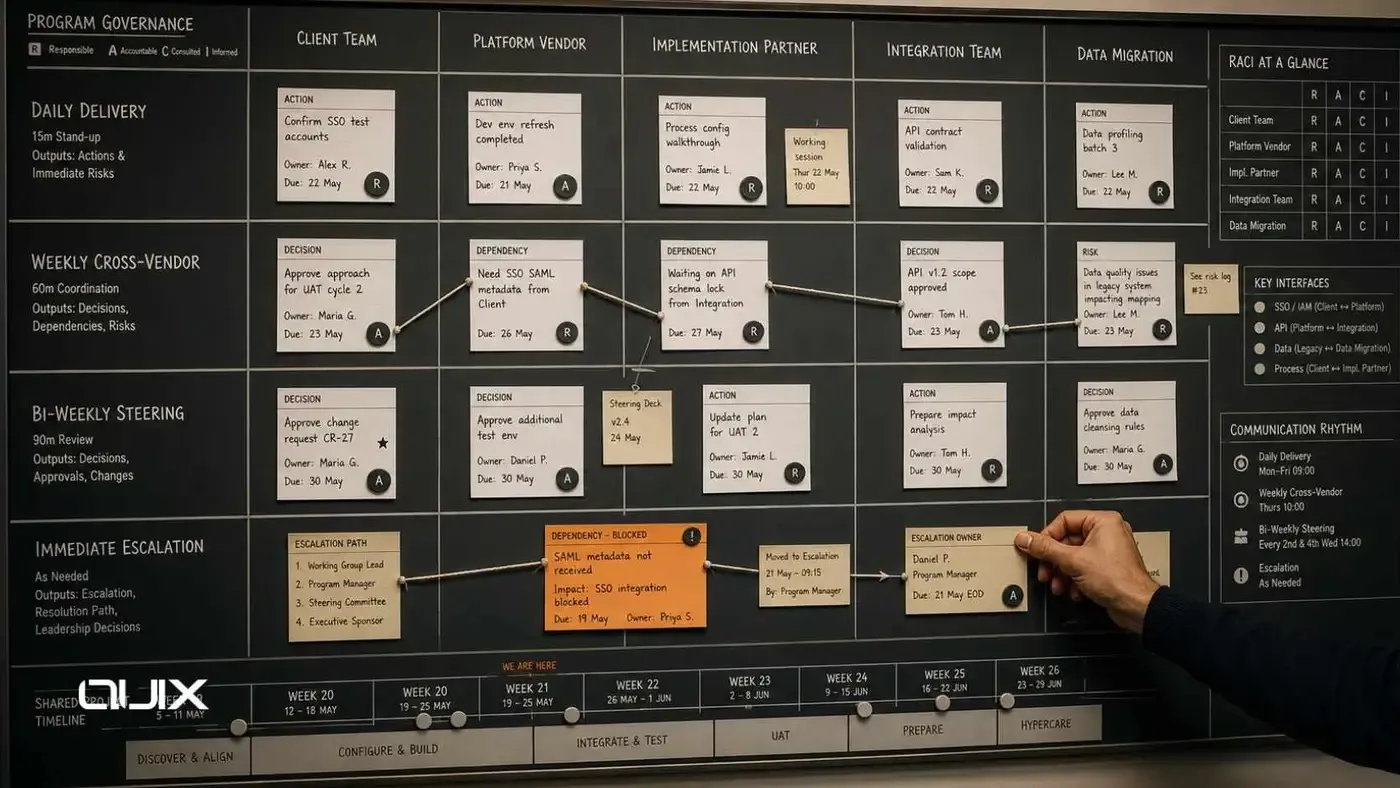
A responsibility map documents, for each deliverable and each decision type, which party is Responsible (does the work), Accountable (owns the outcome and accepts it), Consulted (provides input before the decision or delivery), and Informed (receives notification after).
This model — commonly known as RACI — prevents gap disputes by making scope explicit, prevents decision paralysis by clarifying who has the authority to make each category of decision, and prevents communication proliferation by defining who needs to be involved and at what level.
Dimension 2: Interface Documentation
Interface documentation specifies the deliverables that cross scope boundaries between parties: their content, format, quality criteria, delivery timeline, and the review and acceptance process. When a deliverable changes from one party's scope to another, the receiving party reviews it against the documented criteria before accepting it.
This creates a visible quality gate at each scope boundary rather than allowing quality issues to propagate from one party's work into another's before they are identified.
Dimension 3: Shared Timeline and Dependency Management
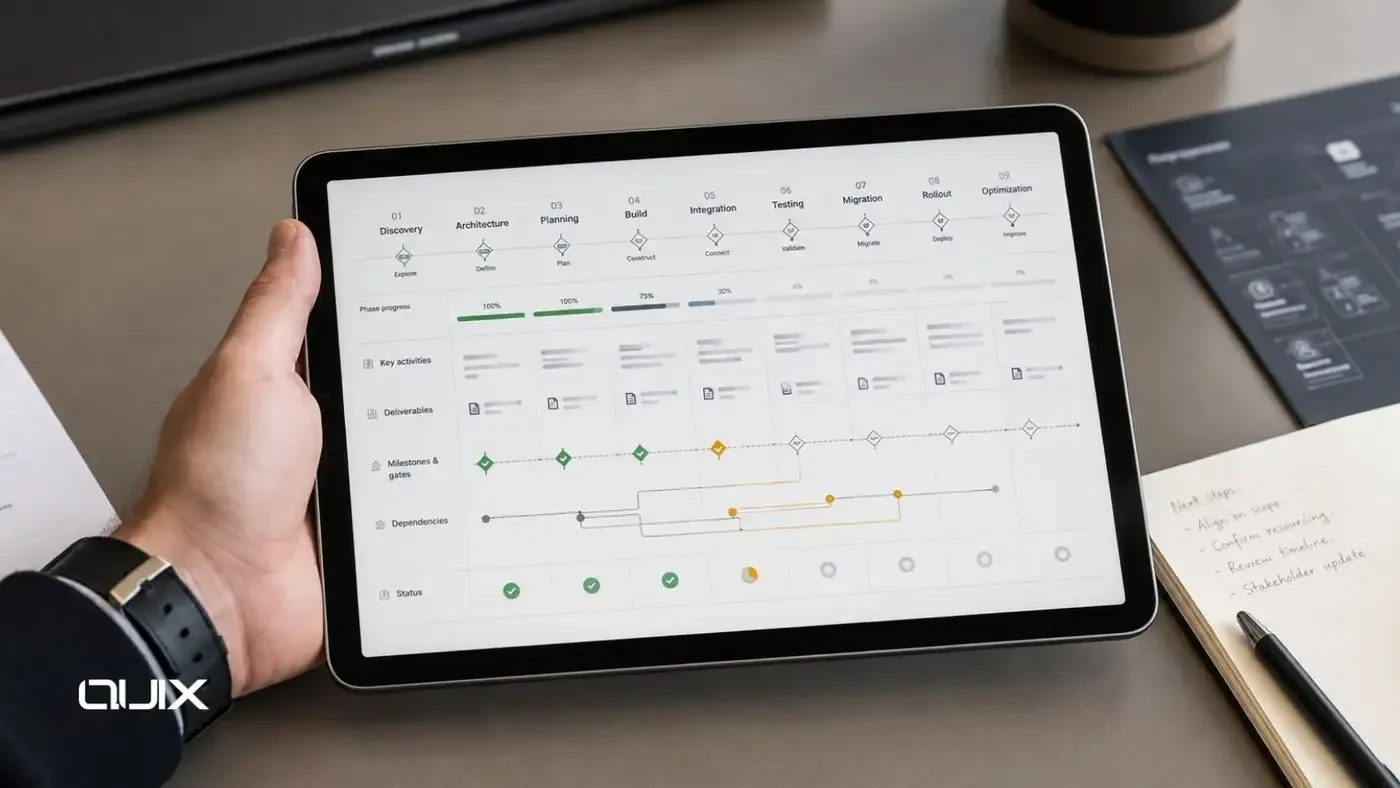
A shared project timeline that shows all parties' deliverables and their dependencies provides the visibility needed to identify when a delay in one party's work will affect another. When the timeline is only shared at a high level, parties do not have enough visibility to anticipate dependency impacts until they have already materialized.
Dependency management requires a defined process for updating the shared timeline when delays occur and for communicating the downstream impact to all affected parties. Delays that are absorbed within one party's scope without communication create surprises for dependent parties.
Dimension 4: Escalation and Decision Authority
Cross-vendor disputes and decisions that cannot be resolved at the working level need a clear escalation path to the authority level that can resolve them. Without it, disputes escalate to the client organization leadership, which is slower, more disruptive, and less informed about the specific technical context than the implementation governance structure.
Define: who resolves working-level disputes within each party's scope, who resolves cross-party disputes, who in the client organization has authority to change scope, and how quickly each level must respond to an escalation before it is elevated further.
Practical RACI Decision Model for Multi-Vendor Implementations
|
Decision or Deliverable Type |
Responsible |
Accountable |
Consulted |
Informed |
|---|---|---|---|---|
|
Solution architecture decisions |
Implementation partner |
Client technology lead |
Platform vendor, integration vendor |
All vendors |
|
Platform configuration |
Platform vendor / implementation partner |
Implementation partner lead |
Client business team |
Client technology lead |
|
Integration specifications |
Integration vendor |
Client technology lead |
Platform vendor, implementation partner |
All vendors |
|
Data migration validation |
Migration vendor / implementation partner |
Client data owner |
Client technology lead |
All vendors |
|
Go/no-go decision |
Implementation partner (recommendation) |
Client executive sponsor |
All vendors (input) |
All parties |
|
Scope change approval |
Implementation partner (assessment) |
Client executive sponsor |
Affected vendors |
All vendors |
Communication Rhythm
Multi-vendor implementations need a structured communication rhythm that provides necessary coordination without creating overhead that consumes delivery capacity. A practical structure for complex implementations includes: daily stand-up for the active delivery team (internal, no vendor overhead), weekly cross-vendor status meeting (all parties, focused on dependencies and risks), bi-weekly client steering review (client leadership, implementation partner, summary of program status), and an ad-hoc escalation path for time-sensitive cross-party issues that cannot wait for the weekly cadence.
Meeting discipline is as important as meeting frequency. Meetings that do not have a defined agenda, a designated facilitator, and documented decisions produce overhead without value. Each cross-vendor meeting should produce: decisions made, actions assigned with owners and due dates, risks identified or updated, and dependencies confirmed or flagged as at risk.
FAQ
What is a RACI model in enterprise vendor coordination?
RACI defines, for each deliverable and decision, which party is Responsible (does the work), Accountable (owns the outcome), Consulted (provides input), and Informed (receives notification). It makes scope and decision authority explicit, preventing gap disputes and decision paralysis.
What are gap disputes in multi-vendor implementations?
Gap disputes occur when a deliverable falls between the documented scope of two vendors and each claims it belongs to the other. They are prevented through explicit interface documentation that specifies which party produces each cross-boundary deliverable, what quality criteria it must meet, and what the acceptance process is.
How should cross-vendor schedule dependencies be managed?
Through a shared timeline that shows all parties' deliverables and their cross-party dependencies, updated when delays occur, with a defined process for communicating downstream impact to all affected parties. Dependencies that are absorbed internally without communication create surprises for downstream parties.
What is the correct escalation structure for multi-vendor disputes?
Working-level disputes are resolved within the party's scope. Cross-party disputes escalate to the implementation program director or lead. Disputes requiring scope or contract changes escalate to the client executive sponsor. Speed of response at each level must be defined — disputes that wait for the next weekly meeting when they are blocking delivery cause unnecessary delays.
How should multi-vendor communication be structured to prevent overhead?
Daily stand-ups for the active delivery team, weekly cross-vendor status focused on dependencies and risks, bi-weekly client steering review, and an ad-hoc escalation path for time-sensitive issues. Each meeting must have a defined agenda, a facilitator, and documented decisions and actions to produce value rather than overhead.