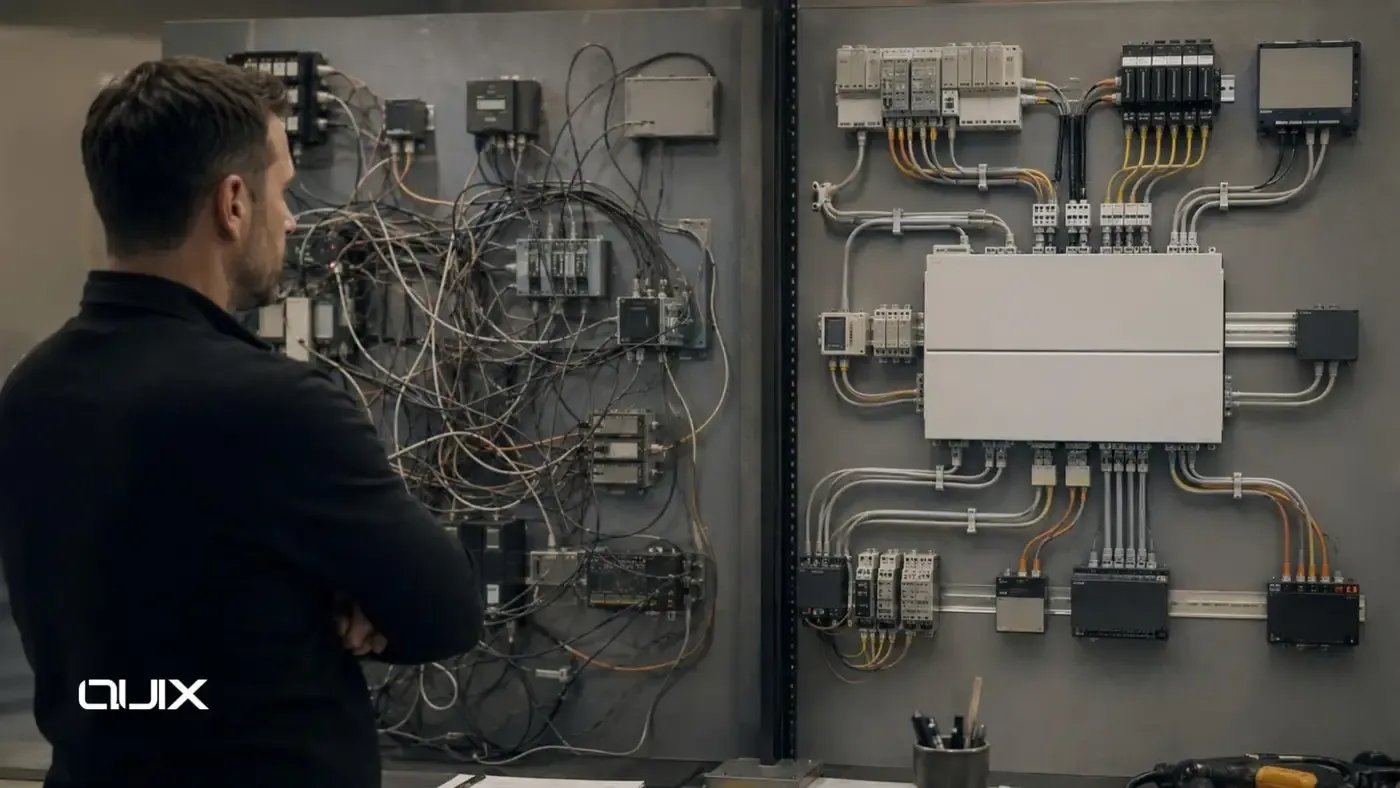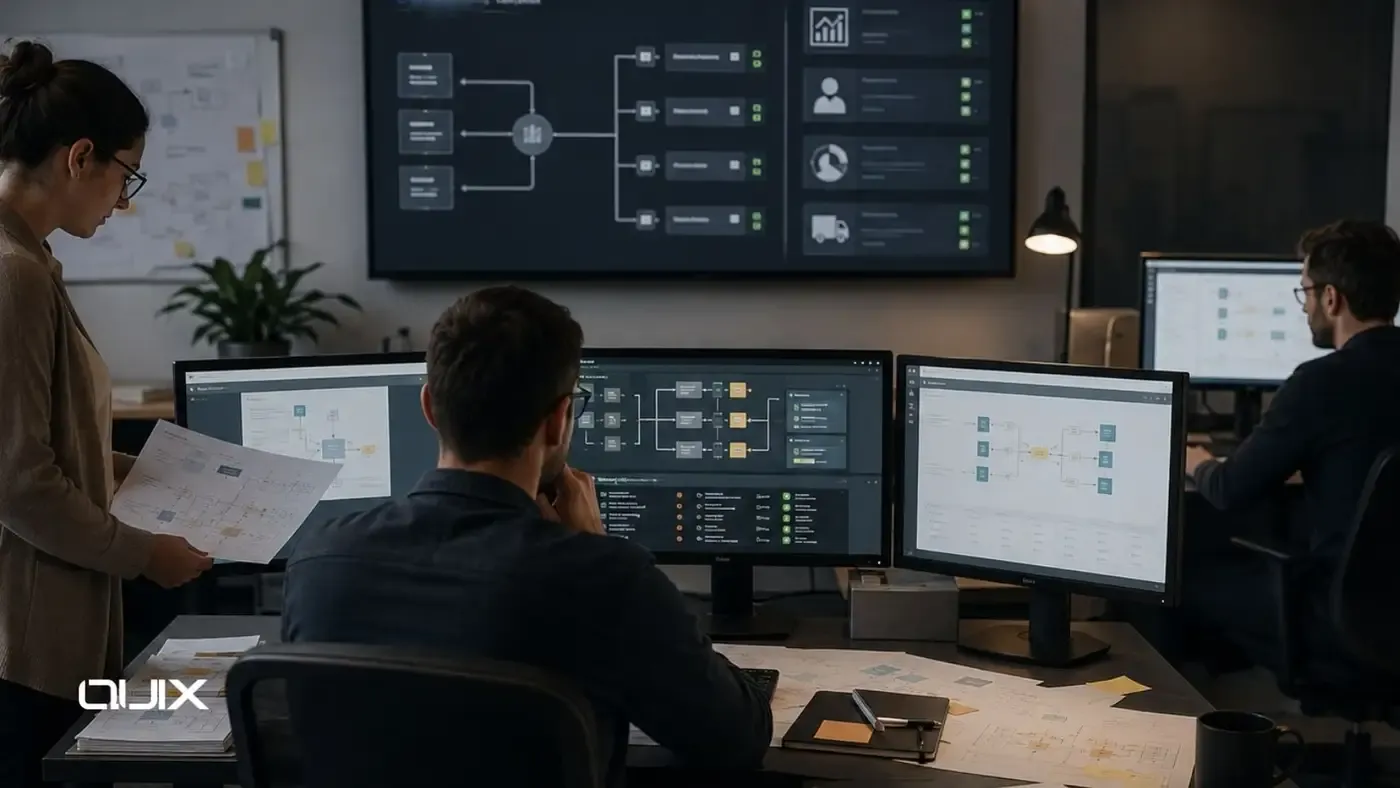
Data latency is a hidden operational cost. When the support team sees a customer status that is twelve hours behind the CRM, they make decisions on information that does not reflect the current state of the account. When a dashboard shows revenue figures from last night's batch load, leadership is managing on data that has already been superseded by a full business day of transactions.
Real-time data synchronization replaces the lag with alignment. It ensures that when something meaningful happens in one system, every other system that depends on that information knows about it immediately — not at the next scheduled sync, not when someone exports a file, not when the batch job runs at midnight.
Executive Summary
Real-time data synchronization is the architectural capability that keeps enterprise systems aligned as operational events occur, rather than on a fixed schedule. It reduces data latency, improves operational visibility, enables responsive automation, and provides the current-context data access that AI systems require to operate effectively.
This article covers the distinction between batch and real-time synchronization, the main technical patterns for implementing real-time sync, the failure handling and governance requirements that make it reliable in production, and a decision model for determining when real-time sync is appropriate versus when batch synchronization is sufficient.
Batch vs Real-Time Synchronization: The Core Trade-Off
Batch synchronization moves data between systems on a fixed schedule: every hour, every night, every week. It is simple to implement, predictable in its resource consumption, and appropriate for use cases where data latency is acceptable — historical reports, end-of-period financial closes, archival processes.
Real-time synchronization moves data in response to events as they occur. It produces lower latency, higher operational responsiveness, and current-context data availability. It is also more complex to implement, more demanding on infrastructure, and more sensitive to failure — because failures in real-time systems affect current operations rather than a past-period batch.
The decision between batch and real-time is not about which is better in the abstract. It is about what the business requires for each specific data flow. Customer payment status needs to propagate immediately to the billing system and the support platform — real-time is appropriate. Historical employee performance data feeding a quarterly analytics model can wait for a nightly batch — batch is appropriate.
The most common mistake is applying one approach uniformly to all data flows. Treating everything as batch creates operational blindness in time-sensitive functions. Treating everything as real-time adds infrastructure complexity and cost to flows that do not require it.
Real-Time Synchronization Patterns
Webhooks
Webhooks are HTTP callbacks that a system sends to a configured endpoint when a specific event occurs. When a record is created or updated in the source system, it posts a payload describing the change to a URL registered by the consuming system or integration layer.
Webhooks are effective for moderate-volume, event-driven notifications between systems that communicate over the web. They are simple to implement for standard use cases, but require explicit handling for failure scenarios: what happens if the consuming endpoint is unavailable when the webhook fires? A reliable webhook implementation includes retry logic, dead-letter handling, and delivery confirmation.
Event Streaming
Event streaming platforms (Kafka, Amazon Kinesis, Azure Event Hubs) provide a durable, ordered log of events that consumers can read from in real time or replay from any point in the history. The source system publishes events to the stream; consumers subscribe and process events at their own pace.
Event streaming is appropriate for high-volume flows, multi-consumer scenarios (multiple systems need the same event), and cases where the ability to replay the event history is operationally important. It provides stronger delivery guarantees than webhooks and better supports the at-scale, real-time patterns that AI and automation use cases require.
Change Data Capture
Change data capture (CDC) reads the transaction log of a database to detect and propagate changes as they occur, without requiring the source application to explicitly publish events. It is used when the source system cannot be modified to emit events but real-time data propagation is required.
CDC is particularly useful for legacy systems that do not have modern API or event capabilities, enabling real-time integration without modifying the legacy system itself.
API Polling with Short Intervals
Near-real-time synchronization can be achieved by polling an API at short intervals — every thirty or sixty seconds. This is simpler than event-driven approaches but more resource-intensive and less responsive. It is appropriate when an event-driven capability is not available from the source system and when latency in the one-to-sixty-second range is acceptable for the use case.
Data Consistency in Real-Time Systems
Real-time synchronization introduces data consistency challenges that batch synchronization does not encounter. When multiple systems are updated simultaneously in response to the same event, there is a window of time during which some systems have been updated and others have not. If a user reads data during this window, they may see an inconsistent state.
Event ordering is a related challenge. In high-volume event streams, events may arrive out of order due to network conditions or processing variability. A consumer that processes a "contract closed" event before it processes the "contract created" event will produce incorrect behavior.
Real-time synchronization architecture must address these challenges explicitly: idempotent event processing (processing the same event twice produces the same result as processing it once), ordering guarantees where required, and consistency monitoring that detects when systems fall out of alignment.
Failure Recovery Design
Real-time synchronization fails. Networks drop. Systems go offline. Events arrive malformed. Downstream systems reject payloads they cannot process. A real-time synchronization architecture that does not design for these failures will produce operational disruptions that are significantly more costly than the data latency it was designed to eliminate.
Failure recovery design should address three scenarios: transient failures (the downstream system is temporarily unavailable), persistent failures (the event format is invalid or the downstream system rejects it consistently), and catastrophic failures (the synchronization infrastructure itself is unavailable).
For transient failures, exponential backoff with jitter and configurable retry limits is the standard approach. For persistent failures, a dead-letter queue captures events that cannot be delivered, along with enough context to diagnose the failure and reprocess the event once it is resolved. For catastrophic failures, the architecture should degrade gracefully to batch synchronization for the affected flows until real-time capability is restored.
Real-Time Synchronization Decision Model
|
Use Case |
Latency Requirement |
Recommended Pattern |
|---|---|---|
|
Payment status update |
Seconds |
Webhook or event streaming |
|
Customer record update |
Minutes acceptable |
Webhook or near-real-time polling |
|
AI model context refresh |
Seconds to low minutes |
Event streaming or CDC |
|
Inventory level update |
Minutes to low hours |
Near-real-time polling or batch |
|
Financial close data |
End of period |
Batch |
|
Employee record changes |
Hours acceptable |
Batch or near-real-time |
|
Compliance audit events |
Near real-time |
Event streaming with durable log |
|
Analytics dashboard data |
Depends on decision speed |
Near-real-time to batch depending on use case |
Real-Time Sync Implementation Checklist
- Is the latency requirement for each data flow clearly defined and matched to the synchronization pattern?
- Are event producers designed to emit structured, versioned events with enough context for consumers to process them correctly?
- Is there retry logic with exponential backoff for transient delivery failures?
- Are there dead-letter queues or equivalent mechanisms for events that cannot be delivered after retry?
- Is event processing idempotent — processing the same event twice produces the same result?
- Are event ordering requirements identified and enforced where necessary?
- Is there monitoring for synchronization lag, failure rates, and dead-letter queue volume?
- Is there a documented degradation procedure for operating under batch conditions during real-time system outages?
- Are data consistency checks run periodically to detect systems that have drifted out of alignment?
- Is the infrastructure designed to handle peak event volume without degrading the operational systems that produce events?
FAQ
What is real-time data synchronization in enterprise systems?
Real-time data synchronization is the capability that propagates data changes between enterprise systems as operational events occur, rather than on a fixed batch schedule. It reduces data latency, improves operational visibility, and enables responsive automation and AI.
When is batch synchronization sufficient instead of real-time?
Batch synchronization is sufficient when data latency does not affect operational decisions — historical reports, end-of-period financial closes, archival analytics, and other use cases where information does not need to be current to be useful.
What is change data capture (CDC)?
Change data capture reads the database transaction log to detect and propagate changes in real time, without requiring the source application to emit events explicitly. It is used when the source system cannot be modified to support event-driven integration.
What is idempotent event processing?
Idempotent event processing means that processing the same event multiple times produces the same result as processing it once. This is required in real-time synchronization systems to handle retry scenarios safely — when a delivery failure triggers a retry, the consumer must be able to process the redelivered event without creating duplicate or incorrect state.
How should real-time synchronization failures be handled?
Use retry logic with exponential backoff for transient failures, dead-letter queues for events that fail after maximum retries, and documented degradation procedures for operating under batch conditions during real-time infrastructure outages. Monitoring should alert on failure rates and dead-letter queue volume.