Most integration projects start with a tool decision. Which iPaaS platform should we use? Which API standard should we follow? Which connector do we need for this pair of systems?
These are legitimate questions. They are also the wrong starting point. Tools connect systems. Quix integrates operations. The distinction matters more than it might appear.
When integration starts with tools, the architecture reflects the tool's capabilities and limitations. When integration starts with operations — with the specific workflows, data flows, governance requirements, and operational outcomes the integration must support — the tool choices that follow are made in full context of what they need to deliver.
Executive Summary
The Quix Enterprise System Integration Framework is a nine-phase methodology for designing and implementing enterprise integration that connects systems around operational requirements rather than tool capabilities. It moves from integration discovery through system mapping, process alignment, data flow design, API strategy, middleware decisions, security, observability, phased rollout, and continuous optimization.
The framework is built on a core principle that distinguishes Quix's approach: integration design precedes tool selection. The architecture defines what the integration must do. The tool choices follow from that definition. This sequence prevents the most common integration failure pattern — an architecture that reflects what the tool can do rather than what the operations require.
This article explains each phase of the Quix framework, why the sequence matters, and what the framework produces as outputs that guide implementation and ongoing integration management.
The Quix Integration Principle: Integrate Around Operations
Quix integrates systems around operations, not just tools. This means the integration architecture is derived from the operational workflows, data requirements, and business outcomes the organization needs — not from the API documentation of the platforms being connected.
The difference shows up in the quality of the resulting integration. An integration designed around the operational workflow accounts for the edge cases that the workflow actually encounters, the data quality requirements that the downstream system actually needs, the error conditions that will actually occur in production, and the governance requirements that the business actually has.
An integration designed around the tool's capabilities accounts for what the tool can technically do. In the best case, this aligns with operational requirements. In the common case, it produces an integration that works in the demo and breaks in the first month of production operation when real operational complexity reveals the gaps.
The Nine Phases of the Quix Enterprise System Integration Framework
Phase 1: Integration Discovery
Discovery maps the current integration landscape: which systems exist, how they currently share data (or do not), what manual bridges are in place, and what integration failures are currently causing operational impact.
Quix discovery in the integration context combines system inventory, stakeholder interviews, workflow analysis, and integration failure history review. The goal is to understand not just the technical state of the integration landscape, but the operational cost it is imposing — the manual work, the data conflicts, the broken workflows, and the automation and AI initiatives it is blocking.
Discovery outputs include a current-state integration map, a prioritized list of integration gaps by operational impact, and a set of constraints that must be respected in the target integration design.
Phase 2: System Mapping
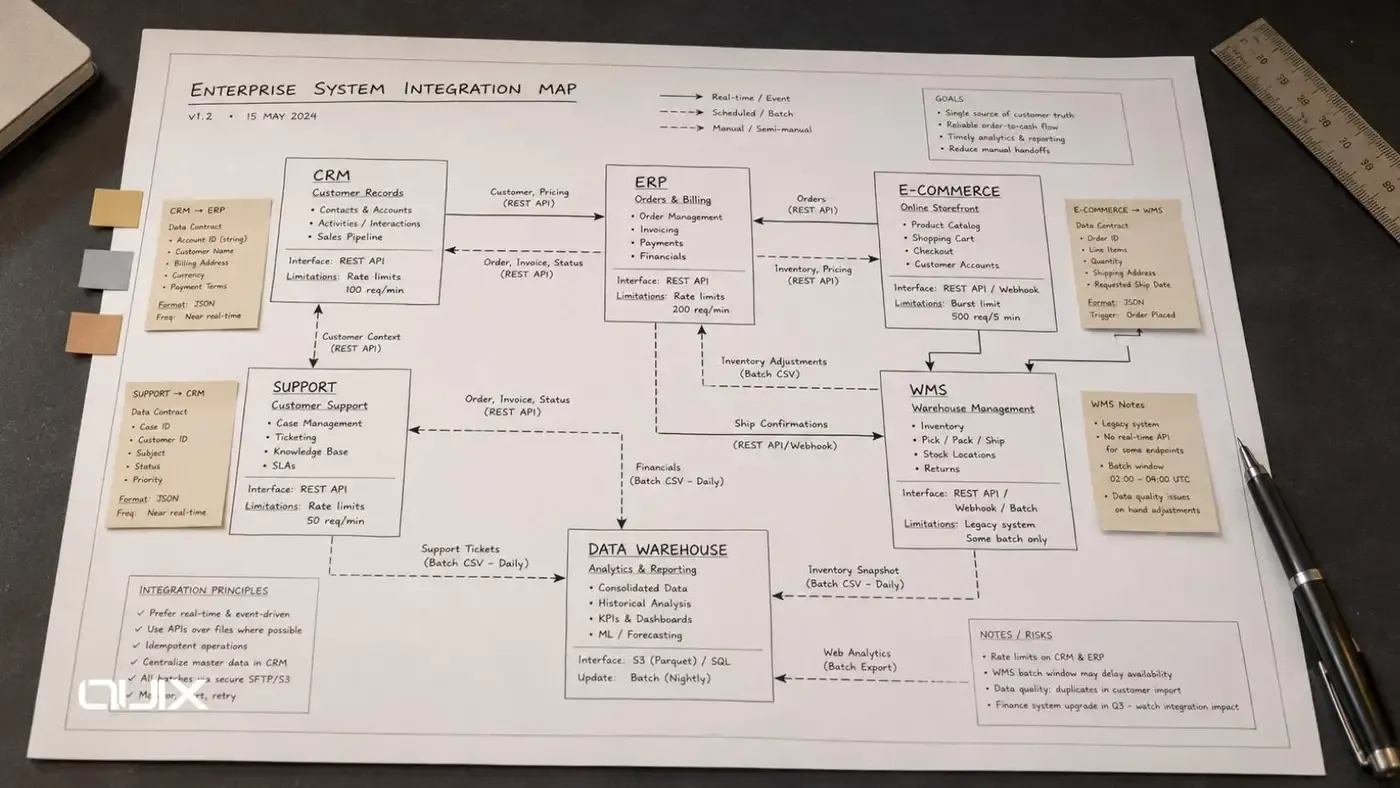
System mapping documents all systems in the enterprise landscape with their data responsibilities, current integration relationships, API capabilities, data format characteristics, and technical constraints.
This phase provides the technical foundation for integration design. It identifies which systems expose modern APIs, which require special handling due to legacy constraints, which have data quality issues that must be addressed before integration will be reliable, and which are candidates for replacement or retirement rather than integration.
Phase 3: Process Alignment
Process alignment connects the integration design to the operational workflows it must support. For each critical integration flow, Quix maps the business process that depends on it: what triggers the data movement, what the data is used for, who depends on it, what happens when it fails, and what quality standards it must meet.
This phase ensures that the integration architecture serves the operating model rather than the other way around. It also identifies process design issues — inconsistencies, informal workarounds, undefined exception handling — that would produce poor integration outcomes if not addressed before the integration is built.
Phase 4: Data Flow Design
Data flow design specifies how data moves between systems: the trigger conditions, the data entities involved, the transformation rules applied, the direction of the flow, the frequency and latency requirements, and the quality validation rules that must be enforced at each integration boundary.
This phase produces the integration specifications that implementation teams use to build the actual connections. Specifications that emerge from operational requirements and process alignment are significantly more complete and accurate than those produced by looking at API documentation in isolation.
Phase 5: API Strategy and Middleware Decisions
With data flows specified, Quix defines the integration patterns and technology choices for each flow: API-led, event-driven, middleware-based, iPaaS, custom, or hybrid. These choices are made in the context of the data volume, latency, complexity, security, and maintainability requirements defined in the previous phases.
The middleware and iPaaS decision — a common question in enterprise integration engagements — is resolved in this phase based on the specific requirements of each flow, not as a default technology preference. Some flows are well served by iPaaS connectors. Others require custom integration because of complexity, volume, or security requirements that iPaaS cannot accommodate.
Phase 6: Security and Governance Design
Security design defines the authentication, authorization, encryption, audit, and vendor access controls for the integration layer. Governance design defines the policy framework for managing the integration layer over time: credential management, change approval, observability standards, and incident response procedures.
Both are designed before implementation begins. Security and governance that are added after implementation tend to be incomplete, inconsistently applied, and harder to enforce. Integration designed with security and governance as core requirements from the start is significantly more maintainable and compliant.
Phase 7: Observability Architecture
Observability design specifies how the integration layer will be monitored: which metrics will be tracked (latency, error rate, throughput, data quality), which events will trigger alerts, what information will be captured in logs to support incident investigation, and what dashboards will provide operational visibility into integration health.
Integration observability is an operational requirement, not an optional enhancement. Integration failures that are not detected quickly cascade into workflow failures, data quality degradation, and operational disruptions that are significantly harder to resolve than the integration failure itself.
Phase 8: Phased Rollout
The rollout plan sequences integration implementation by dependency, operational impact, and risk. Foundational integrations — those that other integrations depend on — are implemented first. High-impact, lower-risk integrations follow. Complex or higher-risk integrations are implemented after earlier stages have established operational confidence in the integration architecture.
Each stage of the rollout includes validation criteria that must be met before the next stage begins. This prevents the sequential delivery of integrations from compressing the validation work that identifies integration failures before they affect production operations.
Phase 9: Continuous Optimization
Integration is not a solved problem after initial implementation. Systems evolve, business requirements change, and integration performance characteristics shift as transaction volumes grow and usage patterns change.
Continuous optimization includes regular integration health reviews, performance benchmarking against the targets established in the observability design, periodic security audits of integration credentials and access scopes, and a process for evaluating and addressing new integration requirements as the business evolves.
The Quix Integration Framework at a Glance
|
Phase |
Focus |
Primary Output |
|---|---|---|
|
Current-state integration landscape and gap analysis |
Integration gap map and operational impact assessment |
|
Technical capabilities, constraints, and data ownership |
System integration capability inventory |
|
Operational workflows that integration must support |
Process-to-integration requirements mapping |
|
Data movement specifications for each integration flow |
Integration flow specifications and data contracts |
|
Pattern and technology selection per flow |
Integration architecture decisions |
|
Access controls, encryption, audit, and policy framework |
Integration security and governance design |
|
Monitoring, alerting, and incident visibility architecture |
Integration observability design |
|
Sequenced implementation with validation gates |
Integration delivery plan |
|
Ongoing health, performance, and security management |
Integration operations framework |
What Distinguishes the Quix Approach
Two characteristics consistently distinguish Quix integration engagements from standard integration projects.
The first is the operational grounding. Every integration flow in the Quix framework has a documented operational workflow it supports, specific data quality requirements it must meet, defined failure handling procedures, and measurable outcomes it is expected to deliver. This level of specificity prevents the common failure pattern of integrations that work technically but do not actually serve the operational purpose they were meant to address.
The second is the security and governance discipline. Quix treats security and governance as design requirements, not compliance afterthoughts. Every integration we design has defined authentication, scoped authorization, appropriate encryption, an audit trail, and a governance process for managing the credential over its lifecycle. This protects the organization both operationally and from a risk management perspective.
FAQ
What is the Quix enterprise system integration framework?
It is a nine-phase methodology for designing and implementing enterprise integration, covering integration discovery, system mapping, process alignment, data flow design, API and middleware strategy, security, observability, phased rollout, and continuous optimization — all grounded in operational requirements rather than tool capabilities.
Why does Quix design integration before selecting tools?
Integration designed around tool capabilities reflects what the tool can do, not what operations require. Designing around operational requirements first produces a more complete and accurate specification, which then informs tool selection. This sequence prevents the most common integration failure: architecture that works in demos but breaks under real operational conditions.
What does process alignment contribute to integration design?
Process alignment connects each integration flow to the specific business workflow it supports. This reveals the edge cases, data quality requirements, failure handling needs, and governance requirements that pure technical integration design misses — and which become the source of production failures when not addressed.
How does the Quix framework address integration security?
Security is designed as a core requirement in Phase 6, before any implementation begins. This covers authentication, least-privilege authorization, encryption, audit trails, vendor access controls, and the governance policy that manages the integration layer over time. Security and governance added retroactively are consistently less complete and more difficult to maintain.
What is continuous optimization in the Quix integration framework?
Continuous optimization is the ongoing management of the integration layer after initial implementation: regular health reviews, performance benchmarking, periodic security audits, and a process for evaluating new integration requirements as the business evolves. Integration is an operational capability that requires active management, not a one-time project.